
MetaTechX BlogSpot | Mechanical Engineering • Manufacturing • Maintenance • Steel Industry • Careers
Completing a mechanical engineering degree or diploma is an important milestone.
But for a fresher entering a steel plant, rolling mill, tube mill, manufacturing facility or heavy engineering industry, academic qualification is only the beginning.
Industrial equipment does not behave like textbook diagrams.
A gearbox may fail unexpectedly.
A bearing may overheat.
A hydraulic cylinder may stop moving.
A conveyor may trip.
A rolling mill may experience vibration.
A production line may stop because of a small component.
When these situations occur, employers need professionals who can understand equipment, identify problems, work safely and make practical decisions.
This is why mechanical engineering freshers should develop skills beyond classroom theory.
The good news is that you do not need ten years of experience to start building these capabilities.
You can begin developing them before your first industrial job.
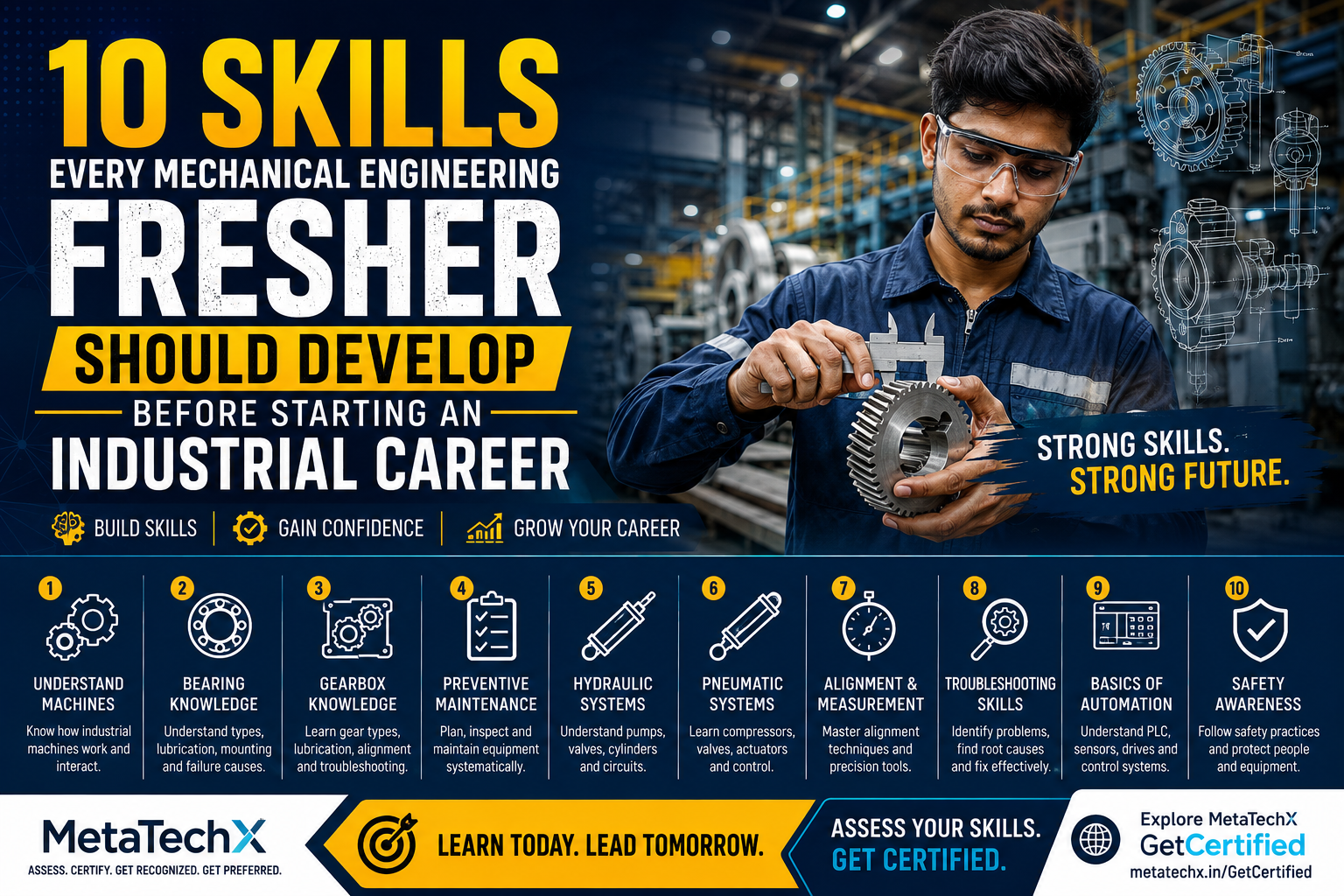
1. Understand How Industrial Machines Actually Work
The first skill every mechanical fresher should develop is equipment understanding.
Do not learn components only as definitions.
Understand how they work together.
For example:
Motor → Coupling → Gearbox → Shaft → Bearing → Machine
If one component fails, the entire system can be affected.
A fresher working in a steel plant may encounter:
Rolling mill stands
Gearboxes
Bearings
Pumps
Compressors
Conveyors
Hydraulic systems
Pneumatic systems
Cranes
Furnaces
Cooling systems
Shears
Straightening machines
Material handling equipment
The ability to look at a machine and understand its function is extremely valuable.
Ask yourself:
What is this machine supposed to do?
How does power reach it?
What components transmit the power?
Where can it fail?
How would I know that it has failed?
This way of thinking develops industrial awareness.
2. Learn Bearings Properly
Bearings are among the most common components encountered in industrial machinery.
Yet many freshers know only the basic definition:
“A bearing reduces friction.”
Industrial maintenance requires much more understanding.
You should learn:
Ball bearings
Roller bearings
Tapered roller bearings
Spherical roller bearings
Thrust bearings
Bearing clearance
Lubrication
Bearing mounting
Alignment
Bearing heating
Failure modes
More importantly, understand why bearings fail.
Common causes include:
Poor lubrication
Overloading
Misalignment
Incorrect installation
Contamination
Excessive vibration
Improper clearance
Shaft problems
A maintenance engineer should not simply replace a failed bearing.
They should ask:
Why did the bearing fail?
That question leads toward root-cause analysis.
3. Develop Gearbox Knowledge
Gearboxes are extensively used in industrial plants.
They transmit power and change speed and torque.
Freshers should understand:
Gear types
Gear ratios
Lubrication
Shafts
Bearings
Seals
Backlash
Gear wear
Gear alignment
Temperature
Vibration
Learn to recognize common gearbox symptoms.
For example:
Abnormal noise
may indicate:
Gear wear
Bearing damage
Lubrication problems
Misalignment
High temperature
may indicate:
Excessive load
Incorrect lubrication
Bearing problems
Gear problems
Cooling issues
Vibration
may indicate:
Misalignment
Gear damage
Bearing problems
Unbalance
Foundation problems
The goal is to connect:
Symptom → Possible Cause → Inspection → Corrective Action
4. Learn Preventive Maintenance
A fresher should understand the difference between:
Breakdown Maintenance
Repair after failure.
Preventive Maintenance
Perform planned maintenance before failure.
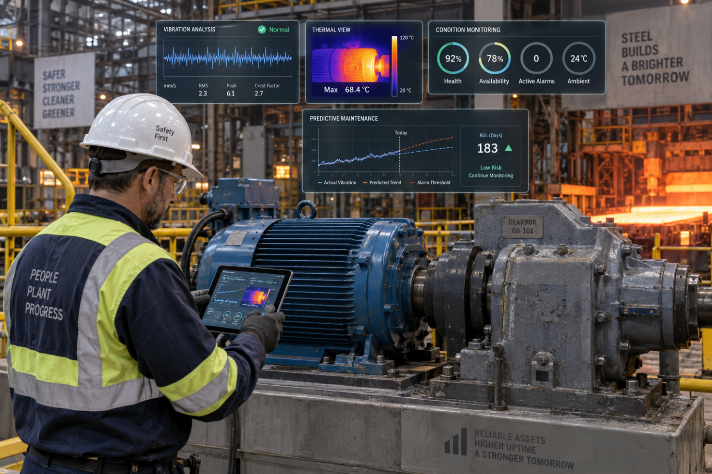
Predictive/Condition-Based Maintenance
Use equipment condition and data to determine when intervention may be required.
Industrial organizations increasingly aim to reduce unplanned downtime.
Freshers should therefore become familiar with:
Inspection schedules
Lubrication schedules
Bolt tightening
Alignment checks
Vibration monitoring
Temperature monitoring
Wear measurement
Condition monitoring
Maintenance records
A good maintenance engineer does not wait for machines to fail.
They look for evidence that a machine may be heading toward failure.
5. Understand Hydraulics
Hydraulic systems are extremely important in heavy industry.
They can be found in:
Rolling mills
Shears
Hydraulic cylinders
Material handling
Clamping systems
Furnaces
Straightening equipment
Presses
Freshers should understand:
Pump → Valve → Pressure → Flow → Actuator → Return
Learn the basics of:
Hydraulic pumps
Directional control valves
Pressure relief valves
Flow control valves
Cylinders
Accumulators
Filters
Hydraulic oil
Hoses
Seals
You should also understand common problems:
Low pressure
Slow cylinder movement
Oil leakage
Overheating
Jerky movement
Excessive noise
The ability to connect symptoms to potential hydraulic causes is valuable on the shop floor.
6. Learn Pneumatics
Pneumatic systems are another important area for mechanical professionals.
You may encounter:
Compressors
Air receivers
FRL units
Solenoid valves
Pneumatic cylinders
Regulators
Air lines
Learn how compressed air travels from:
Compressor → Receiver → FRL → Valve → Cylinder → Exhaust
Understand common problems such as:
Air leakage
Low pressure
Slow actuator movement
Valve malfunction
Moisture contamination
Cylinder seal failure
A mechanical engineer working around automated machinery should have at least a basic understanding of pneumatic controls.
7. Develop Alignment and Measurement Skills
Correct alignment is critical for rotating equipment.
Misalignment can contribute to:
Bearing failure
Coupling failure
Shaft damage
Vibration
Seal failure
Increased energy consumption
Reduced equipment life
Freshers should learn the principles of:
Shaft alignment
Coupling alignment
Soft foot
Parallel misalignment
Angular misalignment
Dial indicators
Laser alignment
Feeler gauges
Vernier calipers
Micrometers
Measurement skills are particularly important.
A good mechanical engineer does not simply say:
“The shaft looks aligned.”
They measure it.
Industrial engineering depends on evidence—not visual assumptions.
8. Learn Troubleshooting and Root-Cause Analysis
This may be the most important skill on the list.
Anyone can replace a damaged component.
A good engineer asks:
Why did it fail?
Consider a bearing that fails every three months.
Replacing it repeatedly is not a solution.
Investigate:
Bearing failure
↓
Lubrication?
↓
Alignment?
↓
Load?
↓
Installation?
↓
Contamination?
↓
Vibration?
↓
Shaft condition?
↓
Root cause
This approach can prevent repeated failures.
Freshers should become familiar with methods such as:
5 Why Analysis
Fishbone/Ishikawa analysis
Failure mode thinking
Cause-and-effect analysis
Corrective action
Preventive action
The objective is to move from:
Repairing failures
to:
Preventing repeated failures
9. Learn to Work With Electrical and Automation Systems
A modern mechanical engineer cannot afford to completely ignore electrical and automation systems.
Industrial machines are increasingly integrated.
A mechanical machine may be controlled by:
PLC → Sensors → Drives → Motors → Actuators
A mechanical failure may generate an electrical symptom.
An electrical fault may stop a mechanical machine.
For example:
A conveyor stops.
Possible causes:
Gearbox problem
Motor problem
VFD fault
PLC interlock
Proximity sensor failure
Emergency stop
Mechanical blockage
The mechanical engineer does not need to become an electrical engineer.
But understanding the basic interaction between mechanical and automation systems is extremely valuable.
At minimum, learn the fundamentals of:
Motors
VFDs
Sensors
PLCs
HMI
Limit switches
Encoders
Interlocks
This cross-functional knowledge can significantly improve troubleshooting.
10. Develop Industrial Safety Awareness
Technical knowledge without safety awareness can be dangerous.
A fresher entering a plant must understand that industrial equipment can contain:
Electrical energy
Hydraulic pressure
Pneumatic pressure
Rotational energy
Thermal energy
Stored mechanical energy
Chemical hazards
High-temperature materials
Before working on equipment, professionals must follow the plant's approved safety procedures.
Important concepts include:
PPE
Lockout/Tagout
Permit-to-work
Machine guarding
Electrical isolation
Stored-energy isolation
Working at height
Confined-space safety
Hot-work safety
Safe lifting practices
Never attempt to bypass a safety system simply to make equipment operate.
Production is important. Safety comes first.
Bonus Skill: Learn to Read Engineering Drawings
Although this is not included in the main ten, it deserves special attention.
Mechanical engineers should become comfortable reading:
Mechanical drawings
Assembly drawings
Sectional views
P&IDs
Hydraulic circuits
Pneumatic diagrams
Equipment layouts
Basic electrical/control drawings
A drawing is essentially the language of industrial equipment.
If you can read it, you can understand the system before touching the machine.
Bonus Skill: Learn Technical Documentation
Industrial engineers spend significant time working with documentation.
Learn how to understand and prepare:
Maintenance reports
Inspection reports
Breakdown reports
Checklists
SOPs
Equipment histories
Root-cause reports
Spare-parts records
Good documentation helps organizations identify recurring problems.
It also helps engineers communicate technical information clearly.
The Most Important Change: Think Like an Engineer
A fresher should gradually move from:
“What is this component?”
to:
“What function does this component perform?”
Then:
“How can it fail?”
Then:
“How would I detect that failure?”
And finally:
“How can I prevent it from happening again?”
That is the transition from academic learning to engineering thinking.
Academic Knowledge vs Industrial Competency
Engineering education provides the foundation.
But industrial work requires the application of that knowledge.
| Academic Learning | Industrial Requirement |
|---|---|
| Machine Design | Equipment understanding |
| Theory of Machines | Machine behaviour |
| Fluid Mechanics | Hydraulic/pneumatic troubleshooting |
| Materials | Failure analysis |
| Thermodynamics | Industrial process understanding |
| Mechanics | Equipment troubleshooting |
| Manufacturing | Production environment |
| Engineering Drawing | Plant documentation |
| Classroom Problems | Real equipment problems |
Neither side replaces the other.
Academic knowledge provides the foundation. Industrial competency makes that knowledge useful on the shop floor.
What Employers Want From Fresh Mechanical Engineers
Employers generally do not expect a fresher to know everything.
They do expect freshers to show:
Strong fundamentals
Willingness to learn
Safety awareness
Problem-solving ability
Technical curiosity
Basic equipment knowledge
Communication skills
Teamwork
Discipline
Adaptability
One of the biggest mistakes freshers make is pretending to know something they do not.
A better approach is:
“I don't know the answer yet, but I know how I would approach the problem.”
That demonstrates engineering thinking.
A 90-Day Skill Development Plan for Freshers
If you are preparing for your first industrial job, consider a structured approach.
Days 1–30: Fundamentals
Focus on:
Bearings + Gearboxes + Pumps + Hydraulics + Pneumatics
Days 31–60: Maintenance
Study:
Preventive Maintenance + Alignment + Lubrication + Condition Monitoring + Troubleshooting
Days 61–90: Industrial Integration
Develop:
PLC Basics + Sensors + VFD Basics + Drawings + Safety + Root-Cause Analysis
By the end of this process, you may not be an experienced maintenance engineer.
But you will have developed a much stronger industrial foundation.
How Can Freshers Demonstrate Their Skills?
One challenge for freshers is that they have limited work experience.
A resume may contain:
B.Tech / Diploma in Mechanical Engineering
but not much evidence of industrial competency.
Candidates can strengthen their profiles through:
Industrial projects
Internships
Technical training
Practical workshops
Equipment-related projects
Technical assessments
Relevant professional certifications
The objective should not be collecting certificates.
It should be building and demonstrating relevant technical capability.
MetaTechX GetCertified
MetaTechX believes that technical professionals should have opportunities to assess and demonstrate their industry-relevant knowledge.
MetaTechX GetCertified provides professional skill assessments focused on technical areas including:
Mill Equipment & Maintenance
Electrical & Automation
Operations & Production
Steel & Tube Industries
For mechanical engineering freshers, developing knowledge around industrial equipment, maintenance and troubleshooting can be an important part of preparing for a manufacturing career.
An assessment can help candidates identify their strengths and areas that require further development.
Certification can then serve as an additional credential alongside education, projects, training and experience.
Learn. Assess. Improve. Demonstrate.
Explore MetaTechX GetCertified
Final Takeaway
A mechanical engineering degree can open the door to an industrial career.
But what happens after entering the plant depends on how effectively a professional can apply knowledge.
The mechanical engineer of the future needs to understand more than machines.
They need to understand:
Equipment + Maintenance + Automation + Data + Safety + Problem Solving
If you are a fresher, don't wait for your first job to start developing these skills.
Start now.
Study the equipment.
Understand how machines fail.
Learn how maintenance teams work.
Practice troubleshooting.
Develop safety awareness.
Learn basic automation.
Ask questions.
Measure instead of assuming.
And most importantly:
Learn to think like an engineer, not just answer like a student.
Your degree can get you an opportunity.
Your skills can help you make the most of it.
MetaTechX BlogSpot
Industry • Technology • Skills • Careers
Comments 0
Be the first to share your thoughts.
Leave a comment
Your comment will appear after a quick moderation check.