MetaTechX GetCertified | Career & Industry Skills
In today’s competitive technical job market, having an engineering degree, diploma, ITI qualification or years of industrial experience is valuable—but it may not always be enough to differentiate one candidate from another.
For employers in industries such as steel, tube manufacturing, engineering, metals, power and industrial manufacturing, recruitment increasingly involves identifying candidates who possess the specific technical knowledge required for a particular role.
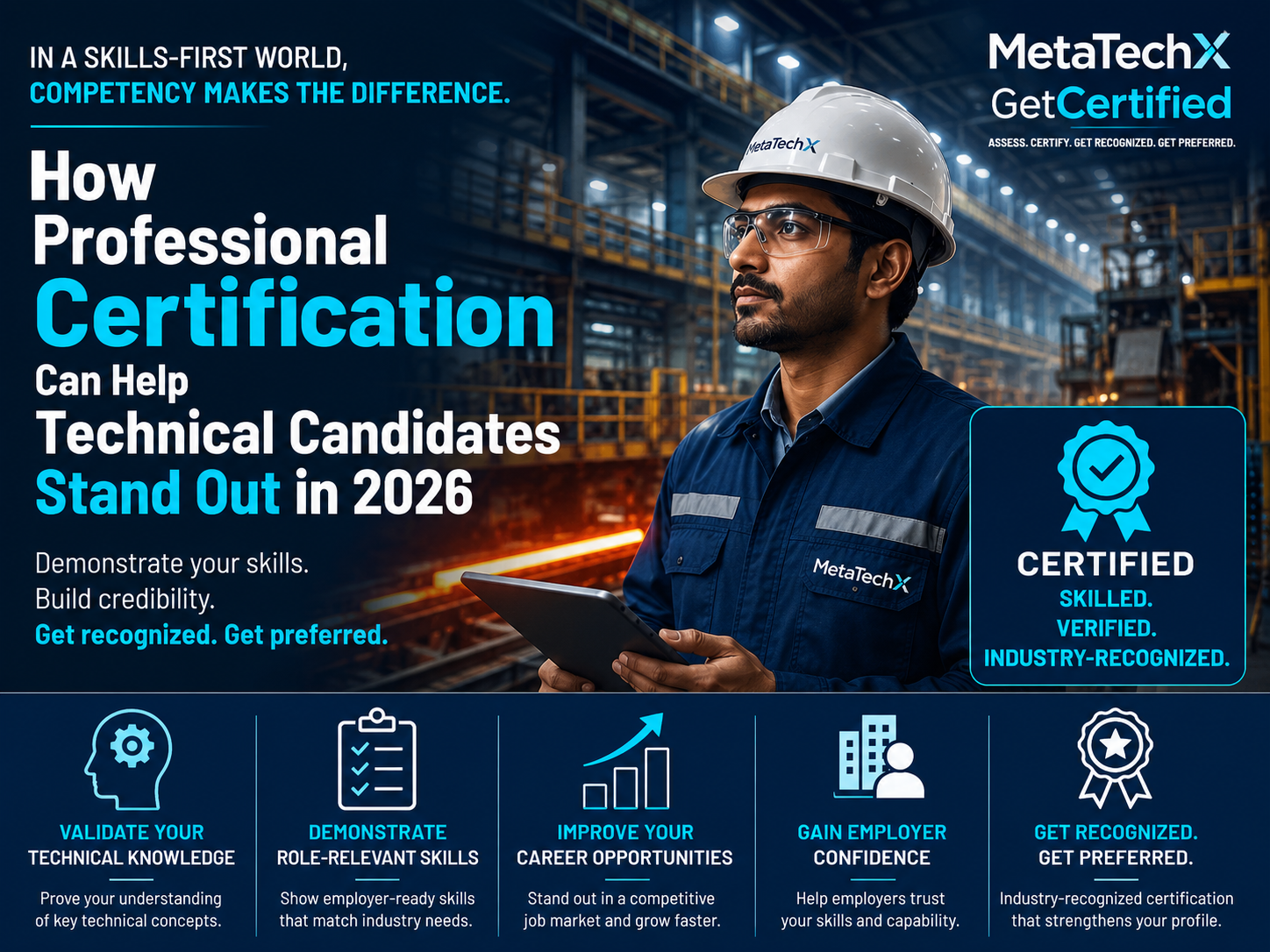
This is where professional certification and skills-based assessment can provide an additional advantage.
Qualification Shows What You Studied. Certification Can Show What You Know.
An academic qualification establishes a candidate’s educational background.
A professional certification can provide additional evidence of knowledge in a specific technical area.
For example:
A Diploma in Electrical Engineering demonstrates formal education in electrical engineering.
But an industry-focused assessment in Electrical & Automation can help demonstrate knowledge related to industrial electrical systems, automation, drives, PLCs, instrumentation and troubleshooting.
Similarly, a mechanical engineering qualification provides a broad technical foundation, while a focused competency assessment can demonstrate knowledge relevant to mill equipment, maintenance and industrial machinery.
The distinction is important:
Education builds the foundation. Professional assessment helps demonstrate applied, role-relevant knowledge.
Why Certification Matters in Technical Recruitment
Recruiters and technical managers often receive numerous applications for the same position.
Candidates may have similar:
Educational qualifications
Years of experience
Job titles
Industry exposure
Technical backgrounds
When resumes look similar, additional evidence of competency can help a candidate create a stronger professional profile.
A relevant certification can act as one such signal.
It does not guarantee employment—and it should never replace practical experience or technical interviews—but it can give employers another factor to consider when evaluating candidates.
1. It Helps Create a Skills-Based Profile
Traditional resumes often focus on:
Education → Experience → Job Title
A skills-focused professional profile can provide a broader picture:
Education → Experience → Technical Skills → Assessment → Certification
This allows a candidate to communicate not only where they studied or worked, but also the technical areas in which they have demonstrated knowledge.
For technical professionals, this distinction can be particularly important.
2. It Can Help Candidates Differentiate Themselves
Consider two candidates with similar qualifications.
Candidate A
Diploma in Mechanical Engineering
4 years of experience
Maintenance experience
Candidate B
Diploma in Mechanical Engineering
4 years of experience
Maintenance experience
Industry-relevant technical assessment
Professional certification
Candidate B has an additional credential that can potentially help differentiate the profile.
The certification itself does not prove that Candidate B is better.
However, it provides additional information for the employer to evaluate.
3. It Demonstrates Commitment to Continuous Learning
Industrial technology changes continuously.
Modern technical professionals increasingly encounter:
Automation
PLC and HMI systems
Variable-frequency drives
Industrial instrumentation
Digital monitoring
Predictive maintenance
Data-driven production
Energy-efficiency systems
Advanced process control
Professionals who continue assessing and developing their skills demonstrate a willingness to keep learning.
For employers, that attitude can be valuable in an environment where equipment and processes continue to evolve.
4. It Can Help Freshers Build a Stronger Profile
Professional certification can be particularly useful for candidates who have limited industrial experience.
A fresher may not yet have:
Major plant experience
A long employment history
Extensive troubleshooting exposure
Multiple projects
But they can still demonstrate their technical preparation.
For example:
B.Tech/Diploma + Industry Skill Assessment + Certification
can communicate a stronger commitment to a particular technical career path.
Certification cannot substitute for plant experience.
But it can help a fresher demonstrate that they have actively developed and tested their technical knowledge.
5. It Can Help Experienced Professionals Validate Their Knowledge
Certification is not only for freshers.
Experienced engineers, supervisors, technicians and operators may also benefit from periodically assessing their knowledge.
Industrial professionals often learn extensively through years of hands-on work.
However, much of that knowledge may never appear on a resume.
A structured assessment can provide an opportunity to benchmark knowledge in a defined technical area.
For example:
10 years of maintenance experience
is valuable.
But a profile stating:
10 years of maintenance experience + demonstrated competency in industrial electrical systems, drives and automation
can communicate the candidate's technical profile more specifically.
6. It Can Improve the Quality of a Technical Resume
A good technical resume should make it easy for an employer to understand:
What can this person do?
Instead of simply listing:
Mechanical Maintenance Engineer
a candidate can highlight specific competencies such as:
Rolling mill equipment
Gearboxes and couplings
Hydraulic systems
Pneumatic systems
Preventive maintenance
Breakdown troubleshooting
Alignment
Lubrication
Maintenance planning
A relevant professional certification can reinforce those skill areas.
7. It Can Support Skills-Based Hiring
The recruitment process is gradually moving beyond the simple question:
“Does the candidate have the required qualification?”
The next question is:
“Does the candidate demonstrate the competencies required for this job?”
This is particularly relevant in technical industries.
A steel plant hiring an electrical maintenance professional may require knowledge of:
Motors → Drives → MCC → PLC → Sensors → Instrumentation → Troubleshooting
A production role may require:
Process Knowledge → Equipment Operation → Quality → Safety → Production Control
A mechanical maintenance role may require:
Equipment → Hydraulics → Pneumatics → Bearings → Gearboxes → Alignment → Troubleshooting
Industry-focused certification can help organize and demonstrate knowledge around these specific competency areas.
Certification Is Not a Replacement for Experience
This point is important.
A certificate alone cannot make someone an experienced engineer.
Technical recruitment should consider multiple factors:
Qualification + Experience + Skills + Practical Ability + Safety + Communication + Assessment
A professional certification should therefore be viewed as an additional competency signal, not as a substitute for real-world industrial experience.
The strongest candidate profile combines demonstrated knowledge with actual workplace capability.
What Makes a Professional Certification Valuable?
Not every certificate carries the same value.
Technical professionals should look for certifications that are:
Relevant
The assessment should relate directly to the candidate's target job or industry.
Skills-focused
It should evaluate actual technical knowledge rather than simply confirming attendance.
Structured
Candidates should understand what competency areas are being evaluated.
Verifiable
Employers should have a way to verify the certification or assessment result.
Industry-oriented
The content should reflect real technical environments rather than only academic theory.
Professionally presented
The certificate and candidate profile should be suitable for inclusion in a professional resume or recruitment process.
Certification + Experience = A Stronger Professional Story
Consider the difference between these two profiles.
Profile 1
Electrical Engineer
5 years' experience in steel plant maintenance.
Profile 2
Electrical & Automation Professional
5 years' experience in steel plant maintenance.
Industry-assessed competency in electrical systems, automation and industrial troubleshooting.
The second profile tells the employer more about the candidate's technical identity.
That is the real purpose of professional certification.
Not simply to collect another certificate—but to communicate competency more effectively.
A New Approach to Career Development
Technical professionals can increasingly think of their careers as a combination of three dimensions:
1. Learn
Build technical knowledge through education, training and self-learning.
2. Apply
Use that knowledge through industrial work, projects, troubleshooting and practical experience.
3. Demonstrate
Use assessments, certifications and professional portfolios to demonstrate relevant competency.
This creates a continuous cycle:
LEARN → APPLY → ASSESS → IMPROVE → CERTIFY → ADVANCE
The Future of Technical Careers
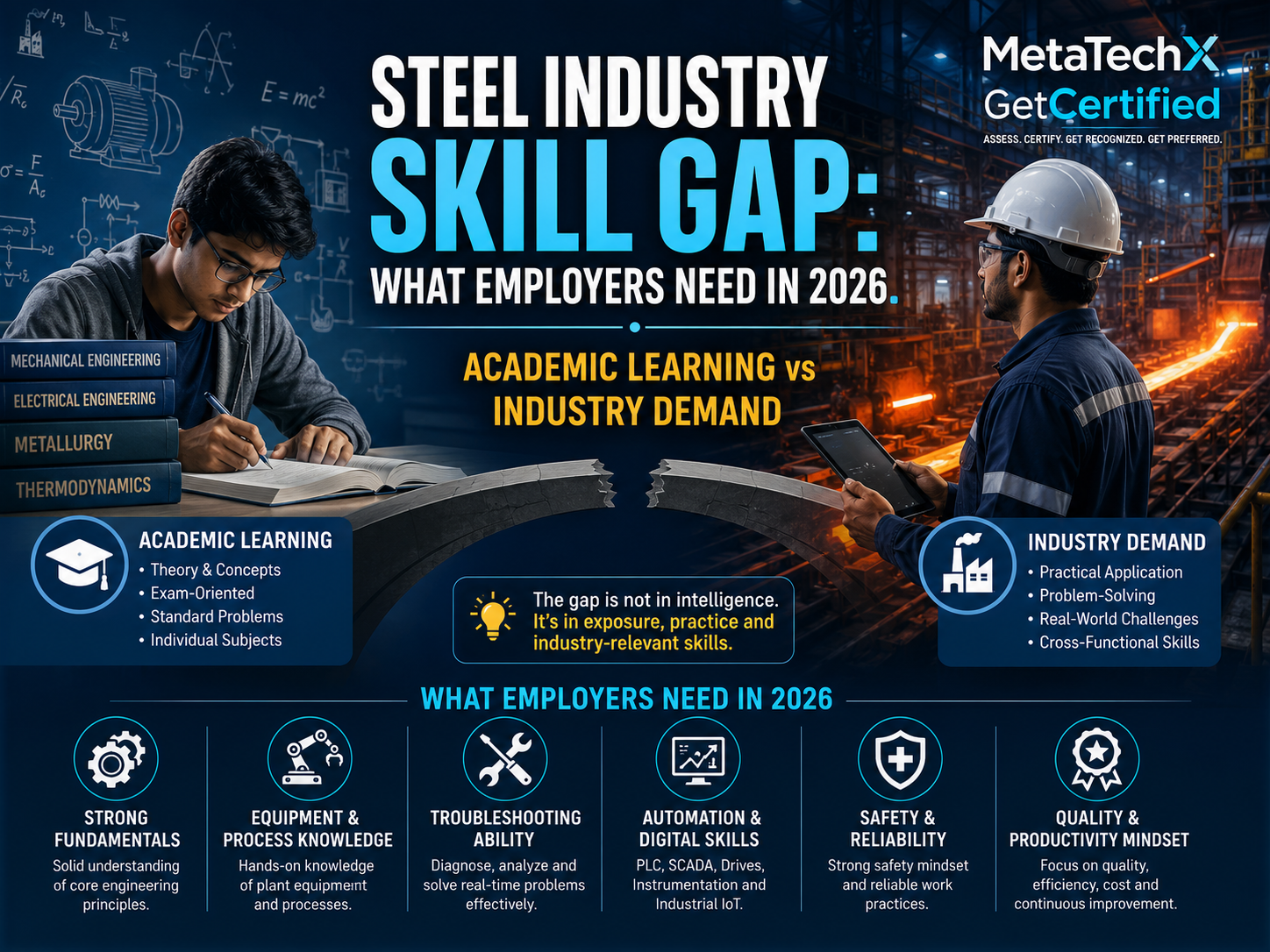
As industries become more automated and technically complex, employers will increasingly need people who can demonstrate specific competencies.
For technical candidates, this means career development is no longer only about collecting degrees or accumulating years of experience.
It is also about being able to answer a simple question:
“What technical skills can you demonstrate?”
Professional certification can help provide that answer.
MetaTechX GetCertified
MetaTechX GetCertified focuses on professional skill assessment for technical professionals working toward careers in the Steel & Tube Industries and related industrial sectors.
Assessments cover industry-relevant areas such as:
Electrical & Automation
Mill Equipment & Maintenance
Operations & Production
The objective is to help technical professionals assess their knowledge and create a stronger, skills-focused professional profile.
Assess. Certify. Get Recognized. Get Preferred.
Whether you are a fresher, diploma holder, ITI professional, engineer, technician, operator, supervisor or experienced maintenance professional, demonstrating relevant technical competency can help you communicate your capabilities more effectively.
Don't just list your skills. Demonstrate them.
Explore MetaTechX GetCertified
MetaTechX editorial perspective. Professional certification should complement—not replace—education, industrial experience, practical evaluation and employer-led technical interviews.

GetCertified platform by MetaTechX is really helpful.