MetaTechX GetCertified | Industry News & Skills Intelligence
India’s steel industry is entering a period of rapid technological and operational transformation. Capacity expansion, automation, digitalisation, energy efficiency and the transition toward greener steel production are changing not only how steel is manufactured—but also what employers expect from technical professionals.
In 2025, the Ministry of Steel conducted a sector-wide Skill Gap Survey involving CPSEs, private integrated steel producers and secondary steel companies to assess workforce readiness, critical skill gaps and future manpower requirements. The Ministry’s 2025–26 Annual Report says the findings are being used to strengthen skilling interventions and improve workforce productivity and quality-driven manufacturing.
The message for technical candidates is becoming increasingly clear:
Having a technical qualification is important. But being industry-ready is becoming even more important.
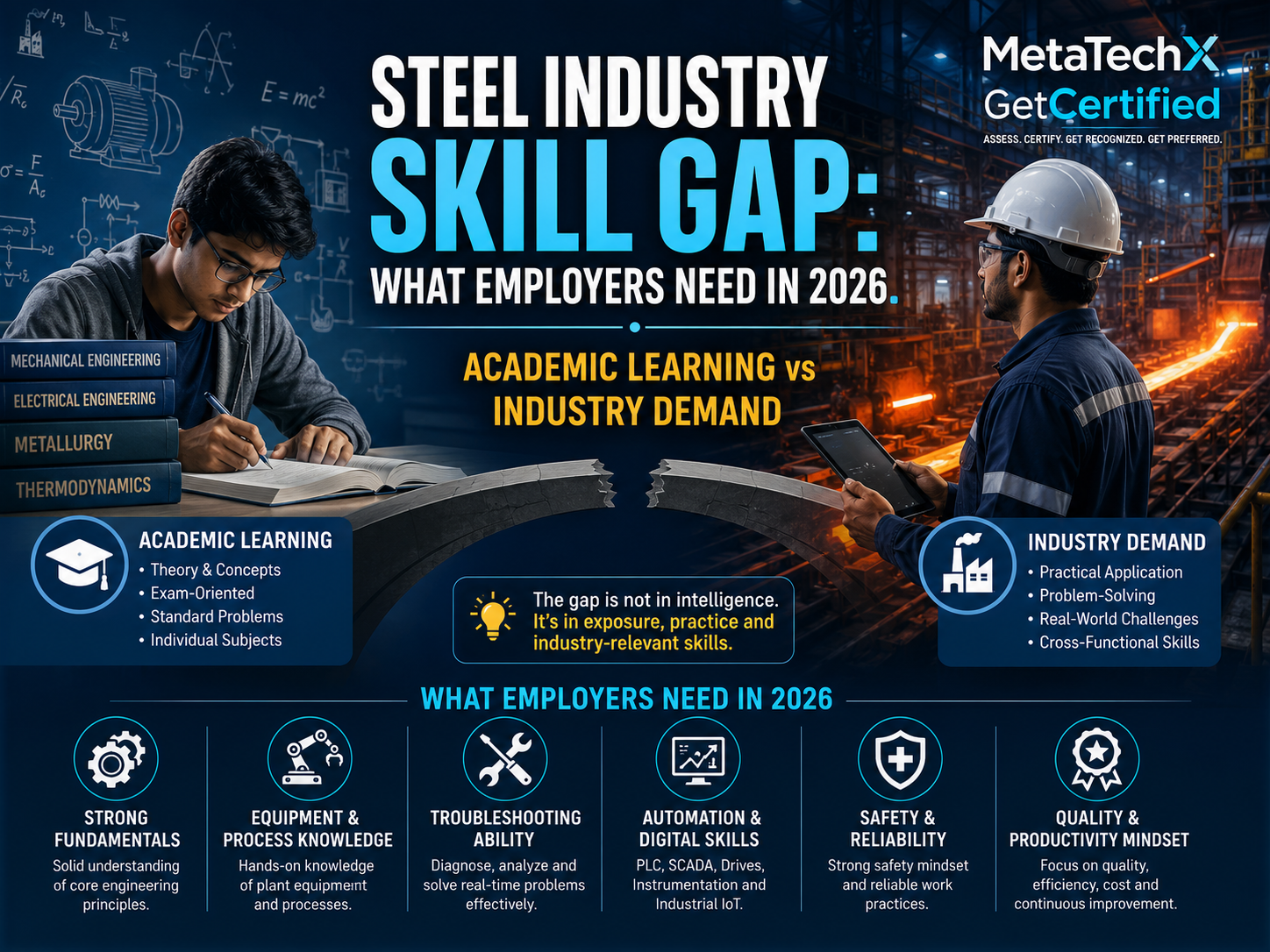
Academic Learning vs. Industry Demand
Engineering colleges, polytechnics and ITIs provide an essential foundation. Candidates learn subjects such as electrical engineering, mechanical engineering, metallurgy, instrumentation, automation, production technology and industrial safety.
However, the steel plant does not operate according to individual academic subjects.
A real production environment integrates multiple disciplines simultaneously.
For example, a mill breakdown may involve:
Mechanical + Electrical + Automation + Instrumentation + Process + Operations + Safety
The engineer or technician has to understand how these systems interact—not simply remember the theory behind each subject.
This creates one of the most important challenges for technical recruitment:
Academic knowledge ≠ complete job readiness
Academic education generally answers:
“What is this system?”
Industry often asks:
“How does this system behave in an actual plant?”
And during a breakdown, the question becomes:
“What is wrong, why did it happen, and what should you do next?”
What Steel Employers Need in 2026
The skills demanded by modern steel plants are becoming broader and more practical.
1. Strong Fundamentals
Employers still need candidates who understand engineering fundamentals.
Electrical circuits, motors, drives, transformers, hydraulics, pneumatics, mechanical systems, metallurgy, process parameters and instrumentation remain critical.
But fundamentals must be connected to actual equipment and processes.
2. Equipment Knowledge
Technical professionals are expected to understand the equipment they work with.
Depending on the role, this may include:
Rolling mills
Furnaces
Induction furnaces
Electric arc furnaces
CCM equipment
Pumps and compressors
Gearboxes
Hydraulic systems
Motors and drives
PLC systems
Sensors and instrumentation
Material handling equipment
Cooling systems
Utility systems
3. Troubleshooting Ability
This is one of the biggest differences between academic learning and industrial work.
Knowing how a motor works is different from diagnosing why a motor has stopped.
Knowing what a PLC is is different from identifying whether a fault originates from an input device, logic, communication network, actuator or field wiring.
Industry needs problem solvers—not only subject learners.
4. Automation & Digital Skills
Steel plants are becoming increasingly automated.
Technical professionals therefore need familiarity with:
PLC → HMI → SCADA → Drives → Sensors → Industrial Networks → Instrumentation → Data
Digitalisation and new technologies are also creating additional reskilling and upskilling requirements across the steel sector. A Ministry of Steel roadmap estimates approximately 0.5 million workers may require reskilling/upskilling over the next ten years, while total incremental direct and indirect manpower requiring skilling and certification is estimated at around 1.1 million.
5. Process Understanding
A maintenance engineer who understands only maintenance may not fully understand the consequences of an equipment failure on production.
Likewise, an operations professional who understands only production may struggle to diagnose an equipment-related problem.
Modern plants increasingly require cross-functional understanding.
6. Safety Competency
Industrial employers need professionals who understand safety as an operational responsibility—not merely as a subject studied for an examination.
Lockout/tagout, electrical safety, hot work, confined spaces, PPE, emergency response, process safety and safe equipment isolation are examples of knowledge that must translate into workplace behaviour.
7. Quality & Productivity Mindset
Modern technical professionals also need to understand:
Quality + Productivity + Reliability + Energy + Safety + Cost
A technically correct solution that creates excessive downtime, quality problems or safety risks is not necessarily a good industrial solution.
The Academic–Industry Gap
The gap is not necessarily because academic education is inadequate.
The real issue is that education and industrial work often measure different outcomes.
| Academic Environment | Industrial Environment |
|---|---|
| Theory | Application |
| Examination | Performance |
| Subject knowledge | Cross-functional knowledge |
| Standard problems | Unpredictable problems |
| Laboratory experiments | Production equipment |
| Individual subjects | Integrated systems |
| Marks | Competency |
| Learning | Decision-making |
| Qualification | Job readiness |
Research on the academia–industry gap in India has similarly identified differences between competencies developed through conventional academic education and those expected by industry, particularly in methodological and practical competencies.
Industry Is Moving Toward Competency-Based Evaluation
This is why the concept of skills-based hiring is becoming increasingly relevant.
The Government of India’s National Skills Qualifications Framework is explicitly competency- and outcome-based, incorporating knowledge, skills, aptitude, responsibility and experiential learning. It also emphasizes stronger partnerships between education, training and employers.
The steel sector is moving in the same direction.
The Ministry of Steel has highlighted experiential learning and employer-relevant skills through initiatives such as BPNSI programmes, industry workshops, recognition of prior learning and short-term skilling programmes.
In April 2026, NISST also launched industry-relevant skill development programmes aimed at improving employability among ITI students and shop-floor employees in the secondary steel sector.
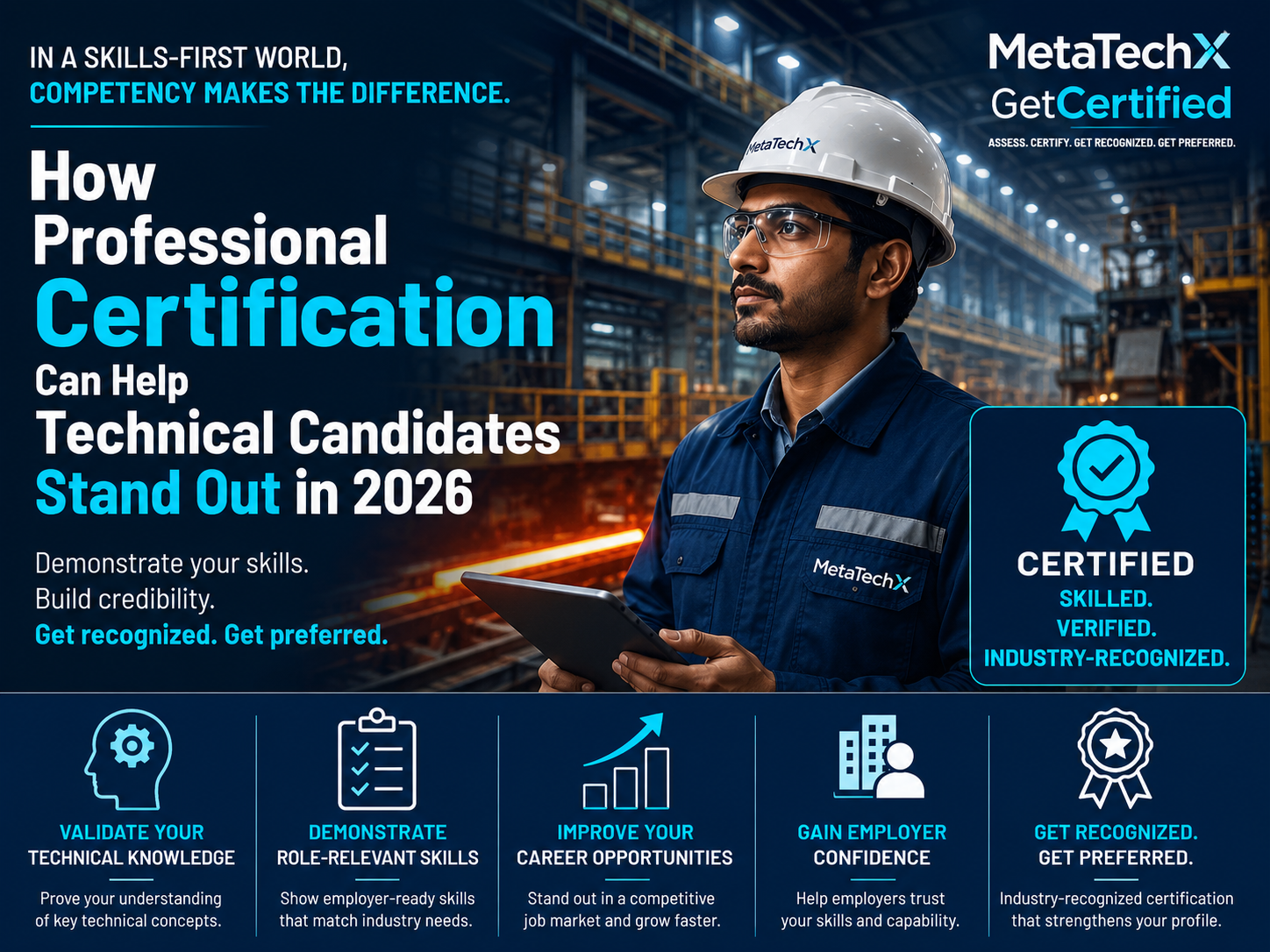
The Candidate Who Can Demonstrate Skills Has an Advantage
Imagine two candidates applying for the same technical position.
Candidate A
Diploma in Electrical Engineering
3 years' experience
Conventional resume
Candidate B
Diploma in Electrical Engineering
3 years' experience
Demonstrated knowledge of industrial electrical systems
Automation and troubleshooting competency
Role-specific assessment result
Professional skills certification
The second profile gives the employer additional evidence to evaluate.
Certification does not replace experience, technical interviews or practical trials.
But it can help answer an important question earlier in the recruitment process:
“Does this candidate demonstrate the technical knowledge required for the role?”
What Technical Professionals Should Do in 2026
Candidates preparing for careers in steel and tube industries should consider developing a skills portfolio, not just a qualification portfolio.
A strong professional profile can combine:
Education
↓
Industrial Experience
↓
Technical Skills
↓
Practical Problem-Solving
↓
Industry-Relevant Assessment
↓
Verified Certification
↓
Career Opportunities
This approach can be particularly valuable for engineers, diploma holders, ITI professionals, operators, supervisors, maintenance personnel and early-career technical professionals.
The Future of Steel Workforce Development
The steel industry's future workforce will need to combine engineering fundamentals with practical competency, digital capability and continuous learning.
The challenge is no longer simply producing more qualified candidates.
The bigger challenge is producing candidates who are ready to contribute inside a real plant.
As India's steel capacity expands and the industry moves toward automation, digitalisation and greener production, the gap between “qualified” and “job-ready” is likely to become an increasingly important factor in recruitment.
MetaTechX GetCertified
MetaTechX GetCertified is built around this skills-first approach.
The platform provides professional skill assessments for technical professionals in areas including:
Electrical & Automation | Mill Equipment & Maintenance | Operations | Steel & Tube Industries
The objective is simple:
Assess. Certify. Get Recognized. Get Preferred.
For candidates, assessment can provide an opportunity to benchmark their technical knowledge and demonstrate industry-relevant competency.
For employers, skills-based assessment can serve as an additional input alongside experience, interviews, qualifications and practical evaluation.
Because the future of technical hiring may not be determined only by what candidates have studied—but by what they can demonstrate.
Prove Your Skills. Elevate Your Career.
Industry perspective by MetaTechX. Certification is one component of professional evaluation and should complement experience verification, interviews and practical assessment.
Comments 0
Be the first to share your thoughts.
Leave a comment
Your comment will appear after a quick moderation check.