MetaTechX BlogSpot | Electrical & Automation | Steel Industry | Industrial Skills
Modern steel plants are no longer simply collections of motors, machines and mechanical equipment.
They are integrated industrial systems in which electrical power, automation, instrumentation, drives, sensors, PLCs, HMI, SCADA and mechanical equipment work together continuously.
A rolling mill, continuous casting machine, tube mill, reheating furnace or material-handling system may contain hundreds or thousands of electrical and automation signals.
When everything works correctly, production appears simple.
When one signal fails, the entire process can stop.
A proximity sensor may fail.
A PLC input may disappear.
An interlock may become FALSE.
A VFD may trip.
A motor may stop.
An encoder may lose feedback.
An HMI may show an alarm.
The final symptom may simply be:
“Machine stopped.”
Finding the actual cause requires an engineer to understand the complete automation chain.
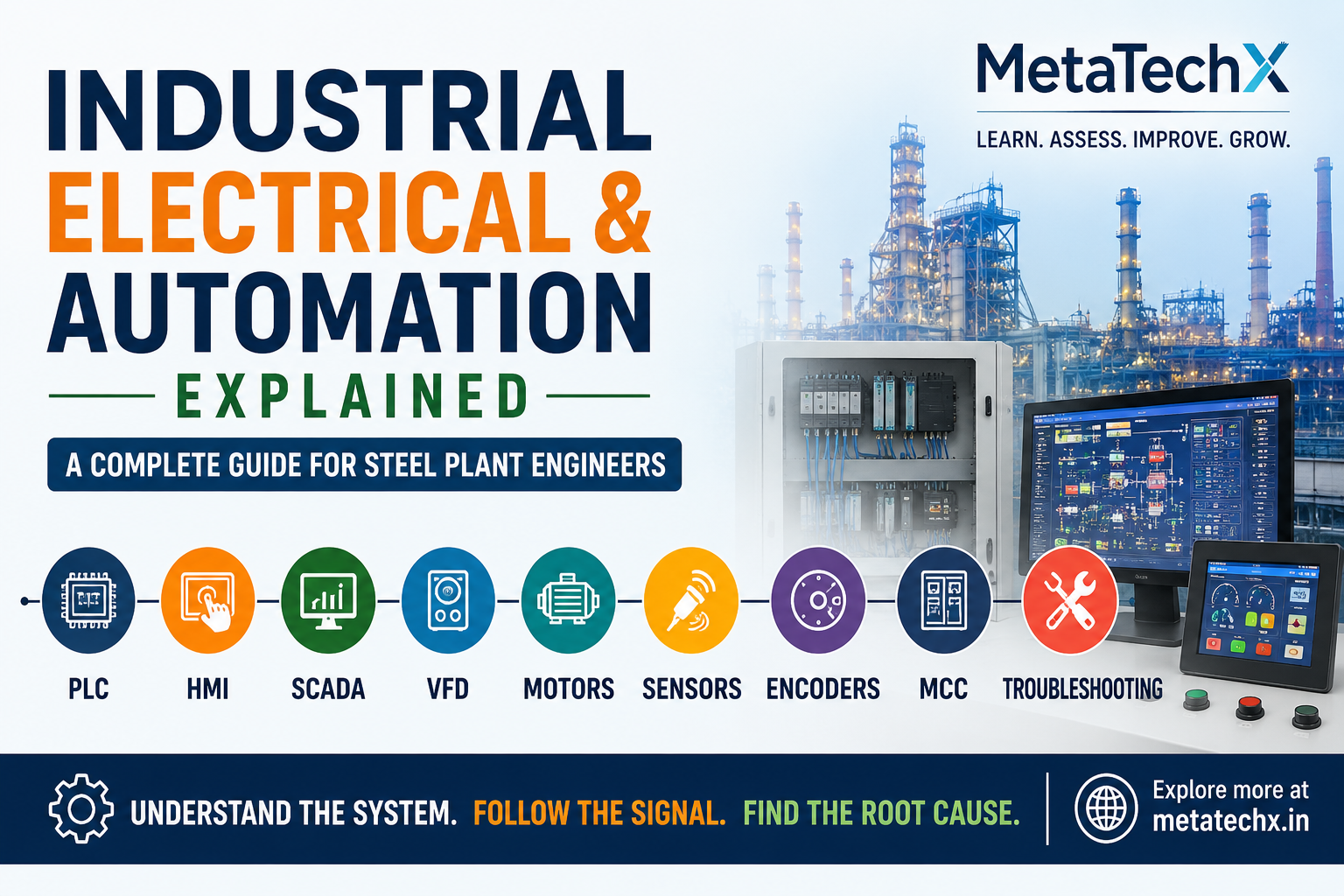
This article provides an introduction to that chain and serves as the MetaTechX Industrial Electrical & Automation Knowledge Hub.
What Is Industrial Automation?
Industrial automation is the use of control systems, electrical equipment, instrumentation, software and machines to monitor and control industrial processes with reduced manual intervention.
A simplified industrial automation system can be represented as:
Sensor → PLC → Logic → Output → Drive/Actuator → Machine → Feedback
Information travels continuously through this system.
A sensor detects a condition.
The PLC receives the signal.
The control program evaluates the condition.
The PLC produces an output.
The output operates a device such as a contactor, solenoid or drive.
The machine performs an action.
Feedback confirms what happened.
The cycle continues.
This basic concept is fundamental to understanding industrial automation.
Why Automation Is Important in Steel Plants
Steel manufacturing requires continuous and coordinated operation of complex equipment.
Automation helps plants achieve:
Consistent production
Faster response
Improved process control
Better product quality
Reduced manual intervention
Improved equipment monitoring
Higher productivity
Better safety
More reliable operation
Data collection and analysis
Automation is particularly important in processes such as:
Steelmaking
Continuous casting
Reheating
Hot rolling
Cold rolling
Tube manufacturing
Coil processing
Material handling
Cooling systems
Hydraulic systems
Utilities
The Basic Architecture of an Industrial Automation System
A useful way to understand industrial automation is to divide it into several levels.
Level 1 — Field Devices
This is where the physical process is measured and controlled.
Examples include:
Proximity sensors
Photoelectric sensors
Limit switches
Temperature sensors
Pressure transmitters
Flow transmitters
Level sensors
Encoders
Solenoid valves
Actuators
These devices interact directly with the machine.
Level 2 — PLC and Control Systems
The PLC receives information from field devices and executes control logic.
It determines what should happen based on:
Inputs
Program logic
Interlocks
Permissives
Timers
Counters
Setpoints
Feedback
The PLC then controls outputs.
Level 3 — HMI and SCADA
Operators and engineers need to see what the system is doing.
HMI and SCADA systems provide:
Equipment status
Process values
Alarms
Trends
Setpoints
Fault information
Production information
This creates the interface between people and automated systems.
Level 4 — Higher-Level Systems
Large plants may also integrate automation with:
Manufacturing execution systems
Production planning
Quality systems
Maintenance management
Energy monitoring
Data historians
Enterprise systems
The result is a connected industrial environment.
Understanding the PLC
The Programmable Logic Controller, or PLC, is one of the most important components in industrial automation.
A PLC can receive inputs, execute programmed logic and control outputs.
A simplified example:
Proximity Sensor
↓
PLC Input
↓
PLC Logic
↓
PLC Output
↓
Motor/Valve
The PLC may also communicate with:
HMI
SCADA
VFDs
Remote I/O
Other PLCs
Robots
Instrumentation
For maintenance professionals, understanding this signal path is essential.
PLC Inputs and Outputs
PLC I/O is broadly divided into:
Digital Inputs
Signals such as:
ON / OFF
Examples:
Push buttons
Limit switches
Proximity sensors
Emergency signals
Auxiliary contacts
Digital Outputs
Commands such as:
ON / OFF
Examples:
Contactor
Solenoid
Relay
Indicator
Analog Inputs
Continuous values such as:
Temperature
Pressure
Flow
Level
Speed
Position
Common industrial signals include:
4–20 mA
and
0–10 V
Analog Outputs
These can be used to control devices such as:
Control valves
Drives
Positioners
Process controllers
Understanding the difference between digital and analog signals is fundamental for automation engineers.
HMI: The Operator's Window Into the Machine
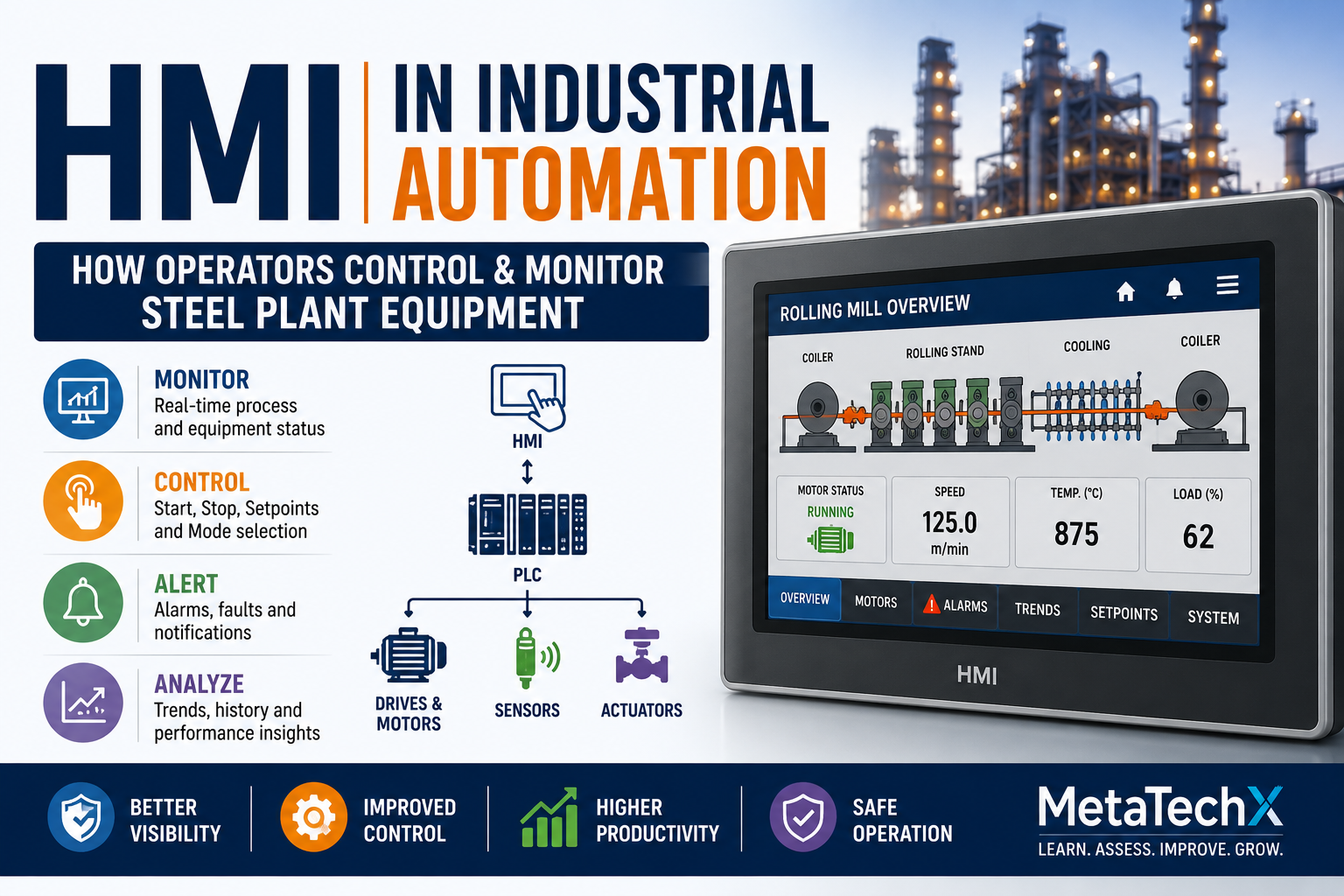
An HMI — Human Machine Interface — allows operators to interact with equipment.
A typical HMI may show:
Motor status
Valve status
Process values
Alarm conditions
Equipment sequences
Manual/automatic modes
Setpoints
Faults
Trends
The HMI does not normally replace the PLC.
Instead:
PLC = Control
HMI = Human Interface
The HMI allows people to see and interact with the control system.
SCADA: Supervisory Monitoring and Data
SCADA stands for:
Supervisory Control and Data Acquisition.
SCADA systems are commonly used for supervisory monitoring and data acquisition across industrial processes.
A SCADA system can provide:
Real-time process information
Alarm management
Historical trends
Equipment status
Data logging
Production monitoring
Remote supervision
A large steel plant can have multiple PLCs and control systems connected to higher-level SCADA infrastructure.
This allows operators and engineers to see a much larger picture of the plant.
HMI vs SCADA
These terms are often confused.
HMI
Generally focuses on interaction with a particular machine or process.
SCADA
Generally provides supervisory monitoring and data acquisition across a larger system.
A simplified relationship is:
Field Devices
↓
PLC
↓
HMI
↓
SCADA
But actual industrial architectures vary considerably by plant, vendor and application.
VFD: Controlling Motor Speed
A Variable Frequency Drive (VFD) controls the speed and operation of AC motors by varying the electrical supply characteristics delivered to the motor.
VFDs are widely used in industrial applications where variable speed or controlled acceleration/deceleration is required.
A simplified system is:
PLC
↓
VFD
↓
Motor
The PLC may provide:
Start command
Stop command
Speed reference
Direction command
The VFD controls the motor according to its configuration and operating conditions.
VFDs can also provide useful diagnostic information.
Common fault categories include:
Overcurrent
Overvoltage
Undervoltage
Overtemperature
Motor overload
External fault
Communication fault
Understanding VFDs is therefore important for modern maintenance professionals.
Industrial Motors
Motors convert electrical energy into mechanical motion.
They drive:
Rolling mill equipment
Pumps
Fans
Conveyors
Compressors
Cooling systems
Hydraulic pumps
Material-handling systems
Common industrial motor types include:
Induction motors
Synchronous motors
DC motors
Servo motors
A motor should never be considered separately from the equipment it drives.
A motor drawing excessive current may have an electrical problem.
But it may also be responding to:
Excessive mechanical load
Bearing problems
Gearbox problems
Mechanical blockage
This is why electrical and mechanical knowledge increasingly overlap.
Sensors: The Eyes and Ears of Automation
Automation cannot control what it cannot detect.
Sensors provide information about the physical process.
Examples include:
Proximity Sensors
Detect the presence or position of objects.
Photoelectric Sensors
Detect objects using light.
Temperature Sensors
Measure temperature.
Pressure Sensors
Measure pressure.
Level Sensors
Measure material or liquid level.
Flow Sensors
Measure fluid movement.
Limit Switches
Provide mechanical position feedback.
Encoders
Provide speed or position information.
Sensors are therefore the connection between the physical machine and the control system.
Encoders: Speed and Position Feedback
Encoders are particularly important in applications requiring accurate motion feedback.
They may provide:
Speed feedback
Position feedback
Direction information
Rotation information
Length measurement
In rolling mills, tube mills and cutting systems, encoder feedback can be important for controlling:
Roll speed
Material movement
Position
Cutting length
Synchronisation
A failed encoder can produce symptoms such as:
Incorrect speed
Position error
Sequence failure
Drive fault
Length error
Understanding encoder signals can therefore be an important troubleshooting skill.
MCC: The Electrical Distribution and Motor-Control Point
MCC stands for Motor Control Center.
MCCs are commonly used to distribute power and control motors and associated equipment.
Depending on plant design, an MCC may contain:
Incomers
Busbars
Circuit breakers
MCCBs
Contactors
Overload relays
Motor starters
VFD feeders
Soft starters
Control circuits
A simplified motor-control path can look like:
Power Supply
↓
MCC
↓
Starter / VFD
↓
Motor
↓
Mechanical Equipment
Understanding this chain helps electrical and mechanical professionals troubleshoot equipment more effectively.
How All These Systems Work Together
Consider an automated conveyor.
A simplified control system might look like this:
Proximity Sensor
↓
Detects material
↓
PLC Input
↓
PLC evaluates conditions
↓
Interlock satisfied
↓
PLC Output
↓
VFD Run Command
↓
Motor Starts
↓
Conveyor Moves
↓
Encoder Feedback
↓
PLC confirms speed
↓
HMI Displays Running
↓
SCADA Records Data
This is the essence of an integrated automation system.
What Happens When Something Fails?
Suppose the conveyor suddenly stops.
The HMI shows:
“Motor Not Running.”
Where should the engineer begin?
Not necessarily with the motor.
The problem could be:
Sensor
↓
PLC Input
↓
PLC Logic
↓
Interlock
↓
PLC Output
↓
VFD
↓
Motor
↓
Mechanical Equipment
↓
Encoder Feedback
The correct troubleshooting approach is to follow the signal path.
The Industrial Troubleshooting Chain
One of the most useful concepts for technical professionals is:
INPUT → LOGIC → OUTPUT → ACTUATOR → MACHINE → FEEDBACK
Let's examine it.
Input
Is the PLC receiving the correct information?
Logic
Is the program allowing the required operation?
Output
Is the PLC producing the expected command?
Actuator
Is the relay, contactor, VFD, valve or other device responding?
Machine
Is the mechanical system capable of performing the requested action?
Feedback
Is the PLC receiving confirmation that the action occurred?
This approach prevents random component replacement.
Interlocks and Permissives
Industrial machines cannot simply be started whenever an operator presses a button.
Safety and process conditions often need to be satisfied.
For example:
Drive Ready
AND
Emergency Stop Healthy
AND
Hydraulic Pressure OK
AND
Lubrication OK
AND
Guard Closed
AND
Material Available
↓
Start Permitted
If any required condition is FALSE:
Start = Not Permitted
This is why an engineer should always check interlocks when a machine refuses to operate.
Automation and Mechanical Engineering Are Becoming Connected
Modern machinery is increasingly mechatronic.
A mechanical engineer may work with:
Gearbox + Motor + VFD + PLC + Sensor + Encoder
An electrical engineer may need to understand:
Motor + Mechanical Load + Gearbox + Pump + Hydraulic System
An instrumentation engineer may need to understand:
Sensor + PLC + Process + Mechanical Equipment
The boundaries between disciplines are therefore becoming less rigid.
This is particularly important in steel manufacturing.
Why Cross-Functional Skills Matter in Steel Plants
Consider a rolling mill.
The machine may include:
Mechanical rolls
Gearboxes
Bearings
Motors
Drives
Encoders
PLCs
Hydraulic systems
Cooling systems
Sensors
HMI
SCADA
A production problem may involve several of these systems simultaneously.
A strong technical professional therefore does not need to know everything.
But they should understand:
How the systems interact.
Skills Modern Electrical & Automation Engineers Should Develop
Technical professionals preparing for industrial careers should consider developing knowledge in:
Electrical
Motors
MCC
Protection
Control circuits
Contactors
Relays
Automation
PLC
HMI
SCADA
I/O
Interlocks
Sequences
Drives
VFD
Soft starters
Drive parameters
Fault diagnostics
Instrumentation
Sensors
Transmitters
Encoders
Analog signals
Communication
Industrial Ethernet
Remote I/O
PLC-to-PLC communication
Drive communication
Troubleshooting
Fault isolation
Root-cause analysis
Signal tracing
Diagnostic methods
Safety
Electrical isolation
Lockout/Tagout
Machine guarding
Safe troubleshooting
Academic Knowledge vs Industrial Automation
Technical education provides the foundation.
But industrial automation requires application.
A student may learn:
Control Systems
Electrical Machines
Instrumentation
Digital Electronics
Programming
Engineering Mathematics
In a plant, these subjects may become one problem:
“The rolling mill has stopped. Find the cause.”
The engineer has to determine whether the issue is:
Electrical
Mechanical
Automation
Instrumentation
Hydraulic
Process-related
This is why practical exposure and troubleshooting ability are so important.
How Freshers Can Start Learning Industrial Automation
You don't need access to a large steel plant to begin learning.
Start with fundamentals.
Stage 1
Understand:
Motors + Contactors + Relays + Sensors
Stage 2
Learn:
PLC Inputs + Outputs + Basic Logic
Stage 3
Learn:
HMI + SCADA
Stage 4
Study:
VFD + Motor Control
Stage 5
Understand:
Encoders + Feedback
Stage 6
Study:
MCC + Protection
Stage 7
Practice:
Troubleshooting + Interlocks + Root-Cause Analysis
This creates a strong learning progression.
The MetaTechX Electrical & Automation Series
This article is the starting point for our detailed Electrical & Automation series.
01 — PLC
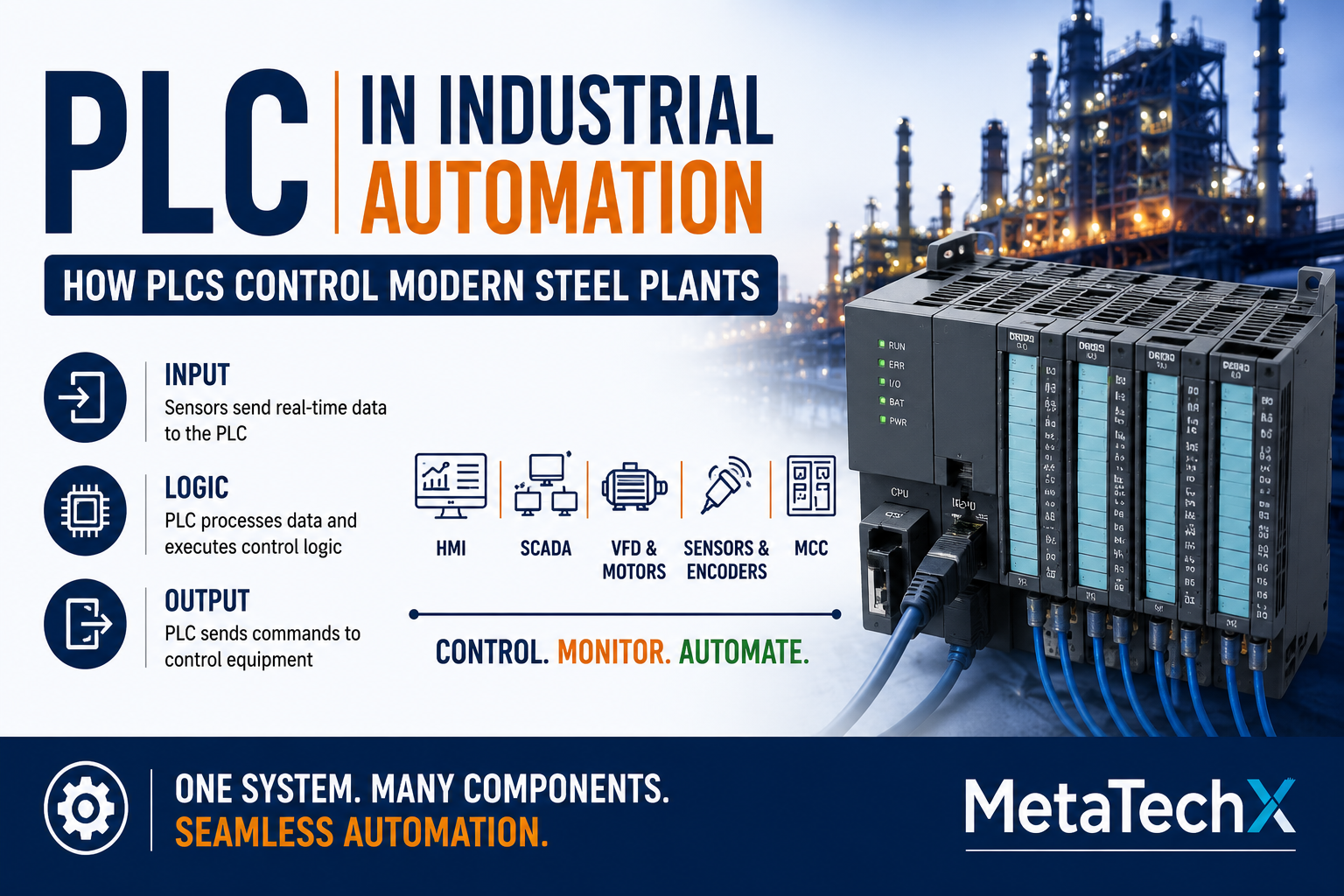
PLC in Industrial Automation: How Programmable Logic Controllers Control Modern Steel Plants
↓
02 — HMI
HMI in Industrial Automation: How Operators Control and Monitor Steel Plant Equipment
↓
03 — SCADA
SCADA in Steel Plants: How Supervisory Control Systems Monitor Production
↓
04 — VFD
VFD Explained: How Variable Frequency Drives Control Motors in Steel Plants
↓
05 — Motors
Industrial Motors in Steel Plants: Types, Applications, Problems and Troubleshooting
↓
06 — Sensors
Industrial Sensors Used in Steel Plants: Types, Applications and Troubleshooting
↓
07 — Encoders
Industrial Encoders Explained: How Steel Mills Measure Speed, Position and Rotation
↓
08 — MCC
MCC Explained: Motor Control Center Components, Applications and Troubleshooting
↓
09 — Troubleshooting
Industrial Electrical & Automation Troubleshooting: A Practical Guide for Steel Plant Engineers
Each article will go deeper into the individual technology while linking back to this master guide.
Why This Knowledge Matters for Technical Careers
The modern steel plant needs professionals who can work with increasingly integrated systems.
A technical professional may be expected to understand:
Electrical + Automation + Equipment + Process + Troubleshooting
This does not mean becoming an expert in every discipline.
It means developing enough knowledge to understand the complete system and identify where a problem may originate.
The most valuable technical professionals are often those who can answer:
What happened?
Why did it happen?
How can I verify the cause?
How can we prevent it from happening again?
That is the foundation of industrial troubleshooting.
Assess Your Electrical & Automation Knowledge
Learning technical concepts is only one part of professional development.
Technical professionals should also periodically assess what they know and identify areas where additional learning is required.
MetaTechX GetCertified provides professional skill assessments for technical professionals in areas including:
Electrical & Automation
Mill Equipment & Maintenance
Operations & Production
Steel & Tube Industries
The purpose is to provide an additional way for professionals to benchmark their technical knowledge and demonstrate relevant competency.
Certification should complement—not replace—education, industrial experience, practical evaluation and technical interviews.
Learn. Assess. Improve. Demonstrate.
Explore MetaTechX GetCertified
Final Takeaway
Industrial automation is not one technology.
It is an interconnected ecosystem:
Sensors → PLC → HMI → SCADA → VFD → Motor → Machine → Feedback
Around this system are:
MCC + Instrumentation + Communication + Safety + Data + Mechanical Equipment
Understanding this architecture gives engineers and technicians a much stronger foundation for troubleshooting and working in modern industrial environments.
For steel plant professionals, automation knowledge is becoming increasingly important.
The engineer of the future will not only understand individual components.
They will understand how the entire system works together.
And when something goes wrong, they will know where to look.
Understand the System. Follow the Signal. Find the Root Cause.
MetaTechX BlogSpot
Industry • Technology • Skills • Careers
Comments 0
Be the first to share your thoughts.
Leave a comment
Your comment will appear after a quick moderation check.