STEEL INDUSTRIES:
THE FUELING POWERHOUSES
Introduction
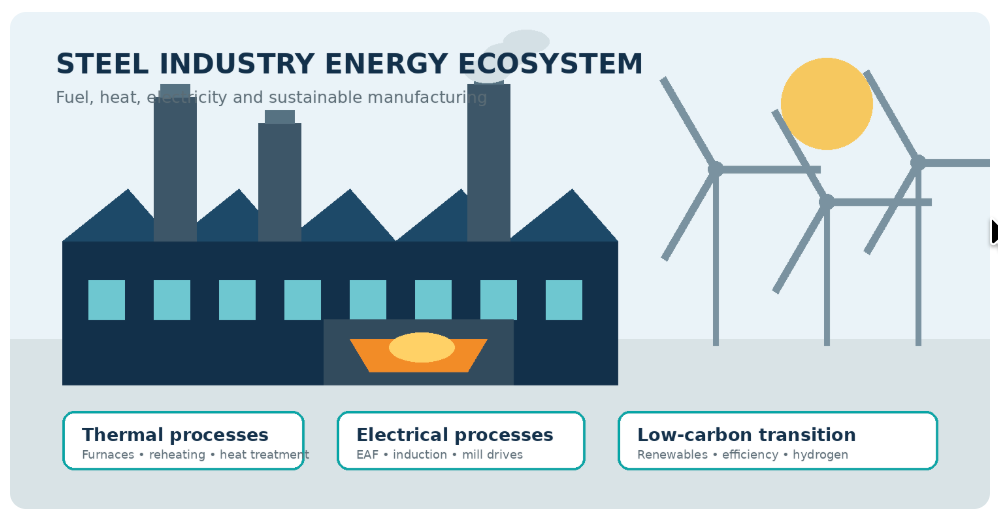
Steel is one of the most important and versatile materials in modern civilization. From infrastructure and transportation to manufacturing, energy, and heavy engineering, steel forms the backbone of industrial development.
However, steel production is among the most energy-intensive industrial activities. The manufacturing process requires substantial thermal and electrical energy for melting, refining, reheating, rolling, and finishing operations.
Fuel selection plays a critical role in determining production efficiency, operating costs, product quality, and environmental performance. With increasing pressure to reduce carbon emissions and improve energy efficiency, steel manufacturers are exploring alternative fuels, advanced combustion technologies, renewable electricity, and hydrogen-based solutions.
In this article, MetaTechX Engineers explores the major fuels used in steel industries, their applications, advantages, limitations, and their potential role in building a sustainable steel manufacturing ecosystem.

1. Major Types of Fuels Used in Steel Industries
1.1 Coal: The Traditional Backbone of Steelmaking
Coal has historically been one of the most important energy sources in the steel industry. Its role extends beyond providing heat, particularly in integrated steel plants. Metallurgical coal is processed into coke, which serves as both a fuel and a reducing agent in blast furnace ironmaking.
Major applications:
· Blast furnace ironmaking
· Coke oven operations
· Sintering plants
· Boiler and power generation systems
· Certain reheating and industrial furnace applications
Advantages:
· Established technology and infrastructure
· High energy content
· Availability in established industrial supply chains
· Essential role in conventional blast furnace processes
Limitations:
· High carbon dioxide emissions
· Significant air pollution potential
· Ash and slag generation
· Environmental compliance challenges
Although coal remains essential to conventional ironmaking, reducing its consumption and developing alternative ironmaking technologies are major priorities for the steel industry.
1.2 Natural Gas: A Cleaner Transitional Fuel
Natural gas has become an increasingly attractive fuel for steel manufacturing because of its relatively lower carbon dioxide emissions per unit of energy compared with coal. It is widely used in thermal processes where precise temperature control and efficient combustion are important.
Major applications:
· Reheating furnaces
· Annealing and heat-treatment furnaces
· Direct Reduced Iron (DRI) production
· Industrial boilers
· Burner systems in rolling mills
Advantages:
· Lower direct CO₂ emissions than coal for comparable heat output
· Cleaner combustion with lower particulate emissions
· Excellent temperature control and efficient combustion systems
· Reduced ash-related maintenance
Limitations:
· Dependence on gas availability and infrastructure
· Price fluctuations
· Methane leakage can increase lifecycle emissions
· Still contributes to fossil-fuel carbon emissions
Natural gas can support industrial decarbonization in the short and medium term, but it should not be considered a completely carbon-free solution.
1.3 Electricity: The Driving Force Behind Modern Steelmaking
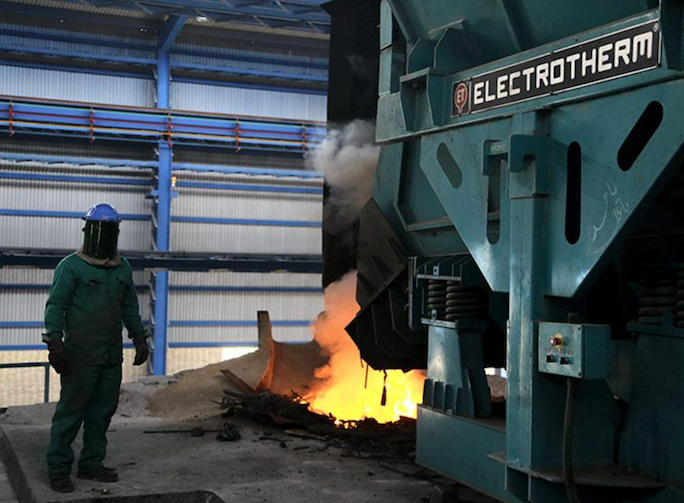
Electricity is a major energy source in modern steel production, particularly in Electric Arc Furnaces (EAFs), induction furnaces, and electrically driven rolling mills. EAFs use electrical energy to melt scrap and other metallic charge materials, while induction furnaces use electromagnetic induction to heat and melt metallic materials.
Major applications:
· Electric Arc Furnace (EAF) and Induction Furnace (IF)
· Continuous Casting Machines (CCM)
· Rolling mill drives
· Pumps, compressors, and auxiliary systems
· Industrial automation and control systems
Advantages:
· High process controllability
· Efficient heat generation at the point of use
· Reduced direct combustion emissions
· Suitable for automation and precision control
· Potential for substantial emissions reduction when powered by renewable electricity
Limitations:
· Electricity consumption can be substantial
· Power quality and grid reliability are critical
· Electricity cost directly affects production economics
· Carbon emissions depend on the electricity generation mix
The environmental performance of electric steelmaking improves significantly when renewable energy sources such as solar, wind, and hydropower contribute to the electricity supply.
1.4 Hydrogen: The Emerging Fuel for Green Steel
Hydrogen is gaining considerable attention as a potential solution for reducing carbon emissions in steel manufacturing. Its most significant application is in hydrogen-based Direct Reduced Iron (DRI) production, where hydrogen can replace carbon monoxide derived from fossil fuels as the reducing agent.
In this process, hydrogen reacts with iron oxide and produces water rather than carbon dioxide as the principal reaction product.
Major applications:
· Hydrogen-based DRI production
· Experimental and specialized furnace heating
· Potential future applications in industrial thermal processes
Advantages:
· No direct CO₂ generated by hydrogen reduction of iron oxide when hydrogen is the reducing agent
· Potential for significant decarbonization
· Compatible with renewable electricity-based production
· Supports low-carbon steelmaking technologies
Limitations:
· High production cost of renewable hydrogen
· Significant electricity requirements
· Storage and transportation challenges
· Infrastructure investment requirements
· Technical challenges in integrating hydrogen into existing plants
It is important to distinguish green hydrogen, produced using renewable electricity, from hydrogen produced using fossil fuels. The environmental benefits depend heavily on the production method. Hydrogen is promising, but widespread adoption requires investment, technological development, and reliable renewable energy infrastructure.
2. Fuel Applications Across Steel Manufacturing Processes
Different steel manufacturing processes require different energy sources depending on operating temperatures, process chemistry, and production requirements.
Steel Industry Process | Major Energy Sources |
Blast Furnace | Coke, coal, injected fuels |
Direct Reduced Iron (DRI) | Natural gas, hydrogen |
Induction Furnace | Electricity |
Electric Arc Furnace | Electricity, chemical energy inputs |
Reheating Furnace | Natural gas, fuel oil, other industrial fuels |
Hot Rolling Mill | Natural gas, electricity |
ERW Tube Mill | Electricity for drives, welding, and auxiliary systems |
Continuous Casting | Electricity and thermal energy for auxiliary operations |
Heat Treatment | Natural gas, electricity, fuel oil |
Important engineering consideration: Fuel requirements vary according to plant configuration, production capacity, equipment design, material specifications, and operating practices.
3. Understanding Fuel Efficiency in Steel Industries
Fuel efficiency is not determined solely by the energy content of a fuel. It depends on how effectively energy is converted into useful heat, mechanical work, or chemical reactions.
Key factors influencing overall energy efficiency:
· Furnace design and insulation
· Combustion system efficiency
· Heat recovery and recuperation
· Process temperature control
· Equipment maintenance
· Production scheduling
· Automation and process optimization
· Waste heat utilization
Fuel / Energy Source | Efficiency Potential | Carbon Impact |
Coal | Highly process-dependent | High |
Natural Gas | High in optimized combustion systems | Lower than coal, but not zero |
Electricity | High at point of use | Depends on electricity source |
Green Hydrogen | Process-dependent | Potentially very low lifecycle emissions |
These comparisons are qualitative. Actual efficiency must be evaluated using plant-specific energy consumption, thermal losses, production data, and lifecycle emissions.
For example, an electrically heated furnace may have high point-of-use efficiency, but its overall environmental performance depends on how the electricity is generated. Similarly, hydrogen may offer significant emissions reductions, but producing it using fossil-fuel electricity can reduce or eliminate its environmental advantage.
4. Energy Optimization in Reheating Furnaces and Rolling Mills
Reheating furnaces are among the major energy-consuming equipment in hot rolling mills. Billets, blooms, and slabs must be heated to the required rolling temperature before entering the rolling stands.
Inefficient furnace operation can result in:
· Excessive fuel consumption
· Increased scale formation
· Uneven billet heating
· Temperature variation during rolling
· Reduced mill productivity
· Higher production costs
Key Energy-Saving Strategies
1. Waste heat recovery
Install recuperators or regenerative burners to recover heat from furnace exhaust gases and preheat combustion air.
2. Improved combustion control
Maintain appropriate air-fuel ratios and optimize burner performance to reduce incomplete combustion and excess heat losses.
3. Furnace insulation improvement
Use appropriate refractory materials and insulation systems to minimize heat losses through furnace walls and doors.
4. Automation and temperature monitoring
Implement advanced temperature measurement and control systems to maintain consistent furnace operation.
5. Minimize billet residence time
Optimize furnace loading, billet tracking, and production scheduling to reduce unnecessary heating and holding periods.
6. Preventive maintenance
Regularly inspect burners, refractory linings, air systems, fuel pipelines, and temperature sensors.
Energy efficiency is not achieved through fuel substitution alone. Proper equipment design, operation, maintenance, and process control are equally important.
5. Which Fuel Is Best for an Environmentally Sustainable Steel Industry?
There is no single fuel that is universally suitable for every steel manufacturing process. The best choice depends on process requirements, availability, cost, infrastructure, and environmental objectives.
Natural Gas: A Transitional Solution
Natural gas can help reduce emissions when replacing coal or heavier fossil fuels in suitable thermal applications. It offers operational flexibility and relatively clean combustion, but remains a fossil fuel.
Renewable Electricity: A Major Decarbonization Opportunity
Renewable electricity can significantly reduce emissions from electric steelmaking, induction furnaces, rolling mills, and auxiliary equipment. Its potential depends on grid infrastructure, renewable energy availability, and electricity economics.
Green Hydrogen: A Long-Term Transformation
Green hydrogen offers one of the most promising pathways for reducing emissions from ironmaking. When produced using renewable electricity and applied to suitable processes, it can support low-carbon steel production. The economics and infrastructure of hydrogen-based steelmaking remain important challenges.

The Most Practical Strategy
For many steel manufacturers, the most effective approach is a combination of:
· Energy efficiency improvements
· Renewable electricity adoption
· Electrification of suitable processes
· Natural gas optimization during transition
· Waste heat recovery
· Hydrogen-based ironmaking where technically and economically viable
A phased transition allows steel plants to reduce emissions while maintaining production reliability and competitiveness.
6. The Future of Steelmaking: Green Steel and Smart Manufacturing
The future of steel manufacturing will be shaped by the integration of cleaner energy sources, digital technologies, and advanced engineering solutions.
Green Steel Production
Manufacturing steel with significantly reduced greenhouse gas emissions through renewable electricity, hydrogen-based ironmaking, and improved process efficiency.
Digital Energy Management
Using industrial automation, sensors, and real-time monitoring to track energy consumption and optimize production.
Predictive Maintenance
Identifying equipment inefficiencies before failures occur, reducing energy waste and production interruptions.
Smart Furnace Technology
Integrating advanced burners, automated temperature control, and heat recovery systems.
Circular Steel Economy
Increasing scrap utilization and improving recycling efficiency to reduce dependence on primary ironmaking.
These technologies will help steel manufacturers improve productivity, control operating costs, and achieve sustainability objectives.
7. MetaTechX Engineers: Engineering Efficiency for Steel Industries
At MetaTechX Engineers, we recognize that energy efficiency, operational reliability, and process optimization are essential for the long-term competitiveness of steel manufacturers.
Our engineering and technical consultancy services support steel industries in improving plant performance through practical engineering solutions.
Our areas of expertise include:
· Steel Melt Shop Engineering Consultancy
· Induction Furnace Operations and Optimization
· Hot Rolling Mill Engineering and Process Optimization
· ERW Tube Mill Design and Technical Consultancy
· Plant Layout and Equipment Integration
· Erection and Commissioning Support
· Industrial Automation Integration
· Operational and Maintenance Consultancy
· Technical Workforce Development and Training
Our objective is to help steel manufacturers improve operational efficiency, reduce avoidable losses, and develop sustainable industrial practices.
Conclusion
Steel remains one of the most essential materials for global industrial development. However, its production requires substantial energy and presents significant environmental challenges.
Coal continues to play an important role in conventional steelmaking, while natural gas offers a transitional option for selected thermal applications. Electricity provides opportunities for efficient and increasingly sustainable production, particularly when sourced from renewable energy.
Hydrogen represents a promising long-term pathway for reducing emissions from ironmaking and selected industrial processes.
The future of steel will not depend on a single fuel. It will depend on intelligent fuel selection, energy-efficient equipment, advanced automation, responsible resource utilization, and continuous engineering innovation.
“The next generation of steel manufacturing will be defined not only by how much steel we produce, but by how efficiently, economically, and sustainably we produce it.”
About MetaTechX Engineers
Engineering Excellence | Industrial Efficiency | Sustainable Steel Manufacturing
Website: https://metatechx.in
Empowering Steel Industries Through Engineering, Technical Consultancy, and Industrial Innovation.
SEO Publishing Details
SEO Title: Fuels Used in Steel Industries: Coal, Natural Gas, Electricity & Hydrogen
Meta Description: Explore fuels used in steel industries, including coal, natural gas, electricity, and hydrogen. Learn about fuel efficiency, industrial applications, and sustainable steelmaking with MetaTechX Engineers.
Suggested URL Slug: steel-industry-fuels-energy-efficiency-green-steel
Target Keywords: Steel industry fuels; steel manufacturing energy; natural gas in steel plants; hydrogen steelmaking; green steel; rolling mill energy efficiency; induction furnace electricity; steel plant energy optimization
Detailed Technical Analysis: Fuel Pros, Cons and Industrial Case Studies
This expanded section adds deeper engineering considerations, practical trade-offs, and documented case studies. Project details are based on public reports and may evolve. The case studies illustrate technology pathways rather than guaranteeing performance at another facility.
1. A Critical Distinction: Fuel, Energy Carrier and Reducing Agent
Steelmaking uses energy in several forms. A fuel may supply heat through combustion; electricity is an energy carrier used for melting, drives and auxiliaries; and a reducing agent removes oxygen from iron ore. These roles are not interchangeable.
· Blast furnace coke provides heat, chemical reduction and physical support/permeability. Replacing it requires process redesign, not just a burner conversion.
· Natural gas can be used as a furnace fuel or as a reducing gas in gas-based DRI.
· Hydrogen can act as a reducing gas in DRI or as a combustible fuel in certain heating applications; the engineering requirements differ.
· Electricity powers EAFs, induction furnaces and mill equipment. Its carbon footprint depends on the generation mix and procurement method.
2. Detailed Fuel Pros and Cons
2.1 Coal and Coke
Coal and coke are deeply integrated into conventional BF–BOF steelmaking. Coke is not simply a heat source: it supports the burden, maintains gas permeability and participates in reduction chemistry.
Advantages
· Mature, proven process with established operating expertise and supply chains.
· Coke has multiple process functions that are difficult to replace in a conventional blast furnace.
· Can be economically attractive where suitable coal/coke supply and infrastructure are available.
· Large-scale production experience and existing plant assets support operational familiarity.
Disadvantages
· High direct and process CO₂ emissions in conventional integrated steelmaking.
· Coal mining, coke ovens, dust, wastewater and solid by-products create environmental burdens.
· Exposure to carbon regulation, environmental compliance costs and transition risk.
· A fuel substitution may affect furnace stability, burden permeability, productivity and hot-metal quality.
Engineering implication: focus first on coke-rate reduction, burden quality, waste-gas recovery, process control and efficiency. Consider alternative ironmaking routes as a strategic plant-level decision.
2.2 Natural Gas
Advantages
· Good combustion control and responsive furnace operation.
· Generally lower direct CO₂ emissions per unit of heat than coal in comparable combustion applications.
· Low ash and relatively low particulate emissions at the point of combustion.
· Widely used in reheating, annealing, heat treatment and gas-based DRI.
· Can provide a transitional fuel in some hydrogen-capable process roadmaps.
Disadvantages
· Still emits CO₂ and remains exposed to fossil fuel price and supply risks.
· Methane leakage upstream can materially affect lifecycle climate performance.
· Requires pipeline, pressure control, gas train, burner and safety infrastructure.
· Gas-to-hydrogen conversion is not automatically a drop-in change: burner stability, flame characteristics, heat transfer, NOx and materials must be checked.
Best fit: thermal processes and DRI systems where local supply, economics, burner design and environmental requirements are favorable.
2.3 Electricity
Advantages
· Precise process control and fast response.
· No direct combustion emissions at the point of electric heating.
· Supports EAF, induction furnace, rolling mill drives and automation.
· Can deliver major emissions reductions when supplied by low-carbon electricity.
· Can improve process repeatability and reduce local combustion pollutants.
Disadvantages
· High peak demand can drive demand charges and require grid/substation upgrades.
· Grid interruptions and voltage/power-quality problems can affect production.
· Emissions depend on the electricity mix; coal-heavy power can reduce the climate benefit.
· EAF and induction routes still require consumables, fluxes, refractories and good process control.
· Scrap quality/availability can constrain scrap-based steel production.
Best fit: EAF and induction steelmaking, mill drives and suitable auxiliary loads. Evaluate electricity tariff, power factor, harmonics, demand profile and renewable sourcing together.
2.4 Hydrogen
Advantages
· Hydrogen-based DRI can substantially reduce direct ironmaking CO₂ when renewable hydrogen is used.
· Can reduce dependence on coking coal in suitable DRI–EAF routes.
· Supports low-carbon steel product differentiation and future climate targets.
· Hydrogen production and storage can potentially be integrated with renewable electricity and flexible operations.
Disadvantages
· Green hydrogen requires large quantities of renewable electricity and expensive electrolysers.
· Storage, compression, pipeline transport, leakage detection and safety are complex.
· Availability, price and infrastructure may be limiting factors.
· DRI requires suitable ore pellets and a compatible shaft furnace/EAF route.
· Hydrogen combustion requires specific burner, NOx, flame and safety engineering.
Best fit: plants with long-term access to renewable power, DR-grade pellets, DRI/EAF infrastructure, hydrogen supply and a credible investment plan.
2.5 Fuel Oil / Diesel
Liquid fuels can remain useful in legacy furnaces, backup systems and locations where gas infrastructure is unavailable.
· Pros: high energy density, established handling in some facilities, useful backup option.
· Cons: emissions and local pollutants, price exposure, storage and spill/fire risk, burner maintenance and compliance burden.
· Recommendation: assess for specific operating needs; generally not the preferred long-term decarbonization pathway.
2.6 Biomass and Biocarbon
· Pros: may substitute some fossil carbon in selected applications; can utilize residues where sustainable supply exists.
· Cons: inconsistent calorific value, moisture, ash/impurity concerns, supply constraints and land-use impacts.
· Important: biomass is not automatically carbon-neutral. Feedstock sourcing, land-use change, processing and transport must be included in lifecycle accounting.
2.7 Waste Heat Recovery
Waste heat recovery is not a fuel but a major energy-saving lever. It can reduce the amount of purchased fuel or electricity required.
· Pros: reduces energy costs and emissions without changing the main fuel; often a practical near-term improvement.
· Cons: capital cost, fouling, corrosion, maintenance, space and process integration challenges.
· Assess exhaust temperature, dust/scale, operating hours, heat demand, maintenance access and payback before investing.
3. Fuel and Process Comparison Matrix
Energy option | Typical steel applications | Main advantages | Main limitations | Role in transition |
Coal/coke | BF–BOF, coke oven, selected boilers | Mature; coke performs multiple blast-furnace functions | High emissions and pollution burden | Reduce consumption; develop alternative ironmaking |
Natural gas | Reheating, heat treatment, gas-DRI | Controllable; lower direct CO₂ than coal for comparable heat | Fossil emissions, methane and price risks | Transitional/process-specific |
Electricity | EAF, induction, drives, auxiliaries | Control, electrification, potential low-carbon supply | Grid capacity, tariff, reliability, grid emissions | Strong if low-carbon power is available |
Green hydrogen | Hydrogen DRI; selected heating trials | Potentially very low direct ironmaking emissions | Power, cost, infrastructure, storage and raw materials | Promising long-term pathway |
Biomass/biocarbon | Selected metallurgical/thermal uses | Potential fossil-carbon substitution | Sustainable supply and quality variability | Niche, site-specific |
Waste heat | Furnace exhaust and hot process streams | Avoided energy use; often practical savings | Integration, fouling, maintenance | Near-term efficiency priority |
4. Case Studies
Case Study 1 — HYBRIT, Sweden: Hydrogen DRI and EAF
HYBRIT is a joint initiative involving SSAB, LKAB and Vattenfall. It has developed and tested a pathway using fossil-free electricity and hydrogen to reduce iron ore to sponge iron, followed by melting in an electric arc furnace. The pilot work included hydrogen production, storage and process integration.
What it demonstrates
· Hydrogen-based reduction can be tested as an integrated value chain rather than as a stand-alone gas substitution.
· The project includes electrolyser production, hydrogen storage, DRI and EAF melting.
· Pilot trials provide evidence for process development and scale-up, but commercial outcomes depend on local electricity, ore, infrastructure and economics.
Pros
· A clear technical pathway to reduce fossil-based ironmaking emissions.
· Integrated research across mining, energy, reduction, storage and steelmaking.
· Hydrogen storage may help manage variable electricity supply and price.
Cons / challenges
· Very large electricity and capital requirements.
· Dependence on DR-grade ore pellets and compatible DRI/EAF equipment.
· Scale-up, commercial costs, infrastructure and market premiums remain critical.
· Pilot results should not be treated as guaranteed full-scale performance.
Engineering lesson: assess the whole chain—renewable electricity, hydrogen, storage, ore, DRI, EAF and product quality. HYBRIT pilot and storage results are valuable, but a local feasibility study remains necessary.
Source: European Commission JRC-INCITE HYBRIT overview; HYBRIT project publications; SSAB hydrogen storage update.
Case Study 2 — HBIS, China: Blended Gas DRI Transition
A 2024 low-carbon technology review by Agora Industry and the Wuppertal Institute describes an HBIS DRI project using a mixture of existing metallurgical gases and externally supplied hydrogen, with CO₂ removal/reuse concepts.
Pros
· Potential transitional pathway that can use existing plant gases and infrastructure.
· May reduce the need for an immediate full hydrogen supply build-out.
· Can support process integration and learning as hydrogen supply expands.
Cons / risks
· Residual fossil gas means the route is not automatically zero-carbon.
· Hydrogen cost and availability remain important.
· CO₂ utilization must be assessed for permanence and lifecycle impact.
· Gas composition affects process control and DRI quality.
Engineering lesson: blended pathways can bridge to lower-carbon operation, but the actual emissions reduction must be measured and transparently reported.
Source: Agora Industry and Wuppertal Institute, Low-carbon technologies for the global steel transformation.
Case Study 3 — European DRI Transition Plans: Natural Gas First, Hydrogen Later
Industry studies describe DRI/EAF conversion strategies in which natural gas may be used initially, with hydrogen introduced as supply and infrastructure mature. Announced project configurations and schedules can change.
Pros
· Staged transition may reduce initial fuel-supply risk.
· DRI–EAF can enable lower-carbon steel when electricity and metallic feedstock are low-carbon.
· Allows gradual workforce, maintenance and process learning.
Cons / risks
· Natural gas operation remains fossil-based and should be reported as an interim step.
· Requires major investment in DRI, EAF, power and gas/hydrogen infrastructure.
· Ore quality, power capacity and hydrogen economics may constrain progress.
Engineering lesson: define milestones for actual hydrogen use and emissions reductions. ‘Hydrogen-ready’ equipment is not the same as operating on green hydrogen.
Source: Agora Industry and Wuppertal Institute low-carbon technology review.
Case Study 4 — Indian Induction Furnace and Rolling Mill: Efficiency Before Fuel Switching
Illustrative case—not a named company: a secondary steel plant in India operates an induction furnace, billet casting and a fuel-fired reheating furnace feeding a rolling mill. Electricity drives melting and mill equipment, while the reheating furnace consumes thermal fuel.
Common baseline issues
· High electricity use due to charge mix, holding time, operating practice or poor power-system performance.
· Reheating losses from excess air, refractory degradation, door leakage and billet waiting.
· Mill motors, pumps, fans and compressed air running during idle periods.
· Insufficient sub-metering makes it difficult to locate the biggest energy losses.
Improvement | Benefit | Potential drawback |
Sub-meter furnace and rolling line | Establishes baseline and identifies loads | Metering investment and data discipline |
Optimize charging and holding | Reduces avoidable melt/holding energy | Requires production coordination and operator training |
Tune burners and excess air | Can reduce fuel use and improve temperature uniformity | Needs qualified burner tuning and safe shutdown planning |
Repair refractory and door seals | Reduces heat loss and improves furnace stability | May require downtime and refractory capital |
Waste heat recuperator | Preheats combustion air and reduces fuel demand | Fouling, corrosion, integration and payback risk |
VFDs and motor optimization | Reduces electricity for suitable variable loads | Not all loads benefit; engineering review required |
Maintenance and SOPs | Sustains gains and reduces energy waste | Needs ownership and regular audits |
Pros of this approach
· Usually lower risk than immediate fuel conversion.
· Operational savings can begin with maintenance, metering and process discipline.
· Can improve billet temperature consistency, yield and productivity.
· Creates credible data for future capex decisions.
Cons / limitations
· Savings depend on actual baseline; no universal percentage can be promised.
· Requires access to plant data and production cooperation.
· Some projects require shutdowns and capital investment.
Engineering lesson: for many Indian plants, an energy audit, metering, furnace optimization and preventive maintenance are the practical first stage before major fuel switching.
Case Study 5 — HYBRIT Hydrogen Storage: Flexibility for Renewable Power
HYBRIT’s pilot hydrogen storage project in Sweden demonstrated a steel-lined rock cavern concept for hydrogen storage. Public project reporting described operating campaigns and potential variable-cost benefits under specific electricity-market conditions.
Pros
· Can separate hydrogen production timing from immediate process demand.
· May improve flexibility where renewable power prices vary.
· Storage can potentially support supply continuity for a large DRI user.
Cons / limitations
· Geology and site conditions may prevent underground storage at other locations.
· Hydrogen containment, material compatibility and safety require specialist design.
· Reported savings are site- and market-specific and should not be transferred directly to another plant.
Engineering lesson: storage is an integrated process, safety and energy-market decision—not simply a tank selection.
Source: SSAB / HYBRIT hydrogen storage update, 27 February 2025.
5. Practical Fuel-Selection Framework for a Steel Plant
Step | Work to complete | Decision output |
1. Define scope | Separate melting, ironmaking, reheating, rolling, utilities and auxiliaries | Clear process boundary |
2. Measure baseline | Fuel, electricity, tonnes, yield, downtime, temperature and product mix | Reliable energy intensity |
3. Identify efficiency | Combustion, insulation, heat recovery, drives, compressed air, scheduling | Low-risk savings list |
4. Technical screen | Fuel quality, burner/process compatibility, safety, supply, materials and quality | Feasible alternatives |
5. Financial/carbon case | CAPEX, OPEX, tariffs, price sensitivity, Scope 1/2 and lifecycle emissions | Business case and abatement cost |
6. Pilot and verify | Controlled test, safety review, product checks and baseline comparison | Evidence before scale-up |
6. Safety and Operational Risk
Fuel conversion must be treated as a process-safety project. Changes in fuel can alter ignition, flame speed, pressure, ventilation, gas detection, combustion products, emergency shutdown and operator response.
· Conduct hazard identification and risk assessment before modifications.
· Use approved gas trains, isolation, purge sequences, flame supervision and detection systems.
· Review ventilation, confined spaces, hot work, electrical hazards and emergency shutdown logic.
· Update operating procedures, maintenance instructions, permits and training.
· Hydrogen requires specialist attention to leakage, ignition, materials compatibility, ventilation and applicable codes.
Do not treat hydrogen conversion as a simple nozzle replacement. Equipment design, safety validation and competent engineering review are essential.
7. Recommendations for Indian Steel Plants
· Begin with process-wise energy metering and an energy audit.
· Prioritize burner tuning, refractory/door maintenance, combustion control and production scheduling.
· Assess waste heat recovery and hot charging where process layout and operating hours support it.
· Optimize induction furnace and mill electrical systems while monitoring power quality, power factor and demand charges.
· Evaluate renewable electricity or captive renewable supply where technically and commercially practical.
· Use natural gas only where supply, cost, equipment and emissions requirements are favorable.
· Track hydrogen DRI developments, but assess ore quality, DRI/EAF compatibility, renewable power, hydrogen logistics and financing before committing.
· Build operator capability through SOPs, training, maintenance routines and periodic energy performance reviews.
Conclusion
No single fuel is the best answer for every steel process. Coal/coke remain integral to conventional blast furnace ironmaking; natural gas can be a transitional or process-specific fuel; electricity is central to EAF, induction and rolling operations; and green hydrogen offers a promising route for low-carbon ironmaking where the entire supply chain is feasible.
For many plants, the most immediate and dependable gains come from eliminating wasted energy, improving combustion, recovering heat, optimizing electrical loads and using measured data to guide investments. Fuel switching should follow rigorous technical, economic, safety and lifecycle-emissions analysis.
“The future of steel is defined not only by tonnes produced, but by energy efficiency, operational reliability and emissions per tonne.”
References and Further Reading
· European Commission JRC-INCITE — HYBRIT technology overview — https://innovation-centre-for-industrial-transformation.ec.europa.eu/innovative-techniques/hydrogen-breakthrough-ironmaking-technology-hybrit
· HYBRIT — Fossil-free steel production ready for industrialisation — https://www.hybritdevelopment.se/en/fossil-free-steel-production-ready-for-industrialisation/
· HYBRIT — Demonstration project overview — https://www.hybritdevelopment.se/en/hybrit-demonstration/
· SSAB / HYBRIT — Hydrogen storage pilot update (27 February 2025) — https://www.ssab.com/en/news/2025/02/hybrit-largescale-storage-of-fossilfree-hydrogen-gas-successfully-proven
· Agora Industry and Wuppertal Institute — Low-carbon technologies for the global steel transformation (2024) — https://epub.wupperinst.org/files/8559/8559_Low-Carbon-Technologies.pdf
· UNIDO — Low-carbon technologies / H₂-DRI-EAF pathway — https://decarbonization.unido.org/wp-content/uploads/2025/08/a-ind_324_low-carbon-technologies_web.pdf
Note: Project status, capacity announcements, fuel prices and local regulations can change. Verify current conditions and site-specific technical data before using this article for investment, design or compliance decisions.
Comments 0
Be the first to share your thoughts.
Leave a comment
Your comment will appear after a quick moderation check.