
A Complete Technical Guide to Composition, Manufacturing, Installation, Sintering, Performance and Refractory Management
1. Introduction
In modern steelmaking, the induction furnace plays an important role in melting sponge iron, steel scrap, pig iron and other metallic charge materials. One of the most critical components responsible for safe and efficient furnace operation is its refractory lining.
The refractory lining separates the molten metal from the induction coil, furnace shell and cooling system. It must withstand high temperatures, chemical reactions, electromagnetic stirring, mechanical abrasion and repeated thermal cycles.
Silica-based ramming mass is one of the most widely used refractory materials for lining coreless induction furnaces, particularly those used for melting cast iron, mild steel and certain low-alloy steel grades.
It is manufactured primarily from high-purity quartz or quartzite, with a carefully controlled particle-size distribution and a boron-based sintering agent.
The performance of silica ramming mass depends not only on its chemical composition but also on:
Raw-material purity and mineralogical characteristics.
Particle-size distribution and packing density.
Binder concentration and distribution.
Installation and compaction practices.
Sintering and first-heat procedures.
Molten-metal and slag chemistry.
Operating temperature and furnace maintenance.
This article explains the engineering principles behind silica ramming mass and its practical application in induction furnace operations.
2. What Is Silica-Based Ramming Mass?
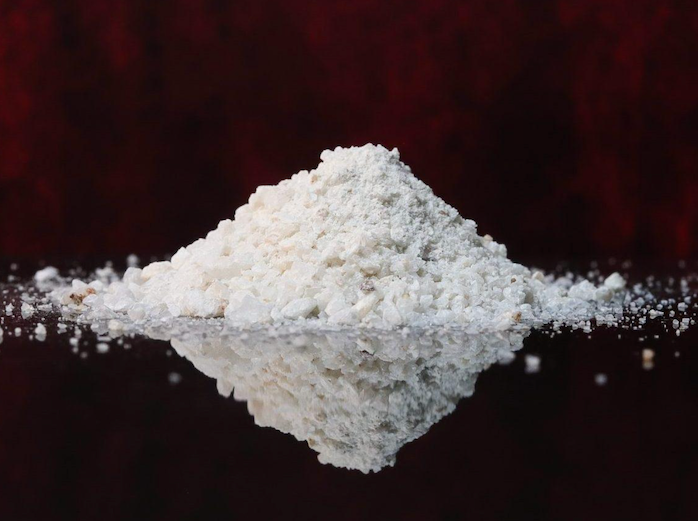
Silica-based ramming mass is a granular, unshaped acidic refractory material used to construct the working lining of a coreless induction furnace.
Its principal constituent is silicon dioxide (SiO₂), generally obtained from selected quartzite or high-purity silica.
The material is supplied as a dry granular mixture with different particle sizes. A boron-containing additive, such as boric acid or boron oxide, is incorporated or specified as a sintering aid, depending on the product formulation.
During installation, the granular material is compacted around a furnace former. Controlled heating subsequently develops a sintered working layer that provides the required mechanical strength and resistance to molten metal.
Main functions:
Protect the induction coil from molten metal.
Maintain a stable crucible shape.
Resist chemical attack from compatible molten-metal and slag systems.
Withstand thermal cycling and electromagnetic stirring.
Minimise refractory erosion and metal penetration.
Support safe and consistent furnace operation.
Silica ramming mass is a consumable refractory. Its working thickness gradually decreases during furnace operation, and the lining must be monitored, repaired or replaced when its condition approaches the site-defined safety limit.
3. Chemical Composition of Silica Ramming Mass
The chemical composition determines the refractory's basic behaviour, high-temperature stability and resistance to chemical attack.
A typical high-purity silica ramming mass contains the following constituents:
| Chemical constituent | Typical characteristics | Function |
|---|---|---|
| SiO₂ | Commonly 98.5–99% or higher | Principal refractory aggregate |
| Al₂O₃ | Controlled minor impurity | Influences high-temperature behaviour |
| Fe₂O₃ | Kept low | Limits undesirable impurity effects |
| CaO | Kept low | Controls impurity-related low-melting phases |
| MgO | Controlled trace impurity | Influences mineral chemistry |
| Boron-containing additive | Product-specific dosage | Promotes controlled sintering and bonding |
These are indicative characteristics, not a universal purchasing specification. Commercial products differ according to the quartzite source, grain structure and binder formulation. Reference: IspatGuru and Mahavir Industries.
3.1 Silicon Dioxide (SiO₂)
Silicon dioxide is the primary refractory component.
Its important characteristics include:
High-temperature refractoriness.
Acidic chemical behaviour.
Resistance to compatible acidic slags.
Thermal stability when properly processed and installed.
Availability of suitable quartzite raw materials.
The silica content alone does not determine the performance of ramming mass. Mineralogical composition, thermal expansion characteristics, particle grading and sintering behaviour are equally important.
3.2 Boric Acid and Boron Oxide
Boron-containing compounds are used as sintering agents.
Commonly used materials include:
Boric acid: H₃BO₃
Boron oxide: B₂O₃
Their purpose is to promote bonding between silica grains during controlled heating.
The quantity must be controlled carefully.
Insufficient sintering aid may result in inadequate bonding, whereas excessive addition can produce excessive liquid-phase formation, undesirable penetration or premature softening.
The exact dosage must be obtained from the refractory manufacturer's approved formulation and technical data sheet.
3.3 Impurities and Their Effects
Impurities such as iron oxide, calcium oxide and alkalis can influence the high-temperature behaviour of silica refractories.
They may contribute to lower-melting phases, reduce refractoriness or increase chemical interaction with the slag.
Therefore, purchasing decisions should not be based solely on the quoted SiO₂ percentage.
4. Raw Materials Used in Manufacturing
4.1 Quartzite
Quartzite is the principal raw material.
It is selected based on:
Chemical purity.
Mineralogical composition.
Crystalline structure.
Thermal expansion behaviour.
Resistance to thermal shock.
Mechanical strength.
Consistency between production batches.
Different quartzite sources may have similar chemical analyses but different thermal expansion characteristics. This can significantly influence the performance of an induction furnace lining.
4.2 Boric Acid
Boric acid is used as a sintering additive in many silica-based refractory formulations.
It promotes the formation of bonding phases during heating.
The additive must be uniformly distributed throughout the granular mixture to avoid local variations in sintering behaviour.
4.3 Particle-Size Fractions
Silica ramming mass is not simply crushed quartzite of one particle size.
It consists of multiple grain fractions designed to produce dense packing.
Larger particles provide the structural skeleton, while smaller particles fill the spaces between larger grains.
A properly designed grading reduces interconnected porosity and improves lining density.
5. Manufacturing Process of Silica Ramming Mass
The manufacturing process involves several controlled stages.
Step 1: Raw Material Selection
High-quality quartzite is selected after chemical and mineralogical evaluation.
The raw material is inspected for:
SiO₂ content.
Impurity levels.
Mineralogical characteristics.
Moisture content.
Physical consistency.
Step 2: Crushing
The selected quartzite is crushed using suitable crushing equipment.
The objective is to produce the required particle-size range without introducing excessive contamination.
Step 3: Screening and Grading
The crushed material is screened into different size fractions.
Typical commercial products may be supplied in 0–4 mm or 0–6 mm grading, but the actual internal distribution is more important than the maximum particle size alone.
Step 4: Proportioning
Different particle fractions are blended according to a designed grading curve.
The objective is to achieve:
High packing density.
Low interconnected porosity.
Uniform compaction.
Consistent installation behaviour.
Step 5: Binder Addition
A controlled quantity of boric acid or boron oxide is introduced according to the product formulation.
Uniform distribution is essential for consistent sintering.
Step 6: Mixing
The ingredients are mixed using suitable industrial mixing equipment.
The mixing process should produce a homogeneous mixture without segregation.
Step 7: Quality Inspection
The finished product is evaluated for:
Chemical composition.
Particle-size distribution.
Moisture.
Bulk density.
Binder concentration.
Flow and compaction characteristics.
Sintering behaviour.
Step 8: Packaging and Storage
The finished material is packed in moisture-resistant bags.
Each bag should preferably carry:
Product grade.
Batch number.
Manufacturing date.
Net weight.
Recommended storage conditions.
Applicable product specification.
6. Particle-Size Distribution and Packing Density
Particle-size distribution is one of the most important factors affecting refractory lining performance.
Consider a mixture containing only large silica particles.
Large particles cannot fill all the available spaces between neighbouring particles. This produces higher porosity.
If smaller particles are introduced, they occupy the spaces between the larger particles.
This increases packing density and reduces the void volume.
Example of a grading concept
The following is an illustrative grading concept, not a standard manufacturing recipe.
| Particle-size range | Illustrative proportion | Purpose |
|---|---|---|
| 1–4 mm | 35% | Coarse structural fraction |
| 0.5–1 mm | 25% | Intermediate packing |
| 0.1–0.5 mm | 20% | Void filling |
| Below 0.1 mm | 20% | Fine matrix and packing |
Actual proportions must be established through particle-size analysis, packing trials and product-performance testing.
Why is packing density important?
Poor packing can result in:
Increased porosity.
Metal penetration.
Localised erosion.
Reduced mechanical strength.
Premature lining failure.
Excessive fines or an unsuitable grading can also reduce permeability and complicate installation.
The objective is not simply maximum fines or maximum density; it is an engineered particle distribution that provides the required installation and service properties.
7. Working Principle of Silica Ramming Mass
The lining does not achieve its final operating strength immediately after installation.
Its performance develops through controlled heating and sintering.
7.1 Initial Granular Structure
After installation, silica grains are mechanically compacted around the furnace former.
At this stage, the lining is primarily a packed granular structure.
7.2 Heating and Thermal Transformation
During the first heating cycle, the lining experiences increasing temperature.
Silica undergoes temperature-dependent mineral transformations and thermal expansion.
Quartz undergoes a reversible alpha-to-beta transformation at approximately 573°C.
Other silica polymorphic transformations occur at higher temperatures, depending on the mineral phases present and the heating conditions.
These transformations influence the volume stability and thermal stresses within the lining.
7.3 Sintering
At higher temperatures, the boron-containing sintering aid promotes bonding between silica grains.
The working face develops a stronger, more coherent sintered structure.
The aim is to develop:
Adequate hot strength.
Controlled bonding.
Resistance to molten-metal penetration.
Suitable mechanical integrity.
7.4 Formation of the Sintered Working Layer
A properly designed and operated silica lining generally develops a temperature gradient through its thickness.
The working face experiences the highest temperature and develops the strongest sintered zone.
The intermediate region may be partially sintered, while the colder outer region remains less strongly bonded.
This graded structure is important because the lining must combine a strong hot face with sufficient thermal accommodation through its thickness.
8. Acidic Refractory and Slag Compatibility
Silica ramming mass is classified as an acidic refractory.
Its suitability depends on the chemical nature of the slag.
8.1 Compatibility with Acidic Slag
Acidic slags generally contain higher proportions of acidic oxides, particularly SiO₂.
Silica lining is chemically more compatible with these slags.
This reduces the tendency for chemical dissolution compared with exposure to strongly basic slags.
8.2 Effect of Basic Slag
Basic slags containing substantial CaO and MgO can react with silica.
These reactions may form calcium silicates and other compounds, depending on the slag composition and temperature.
Such reactions can cause:
Chemical corrosion.
Refractory dissolution.
Penetration into the lining.
Localised softening.
Reduced lining life.
Therefore, silica ramming mass is not automatically suitable for every steelmaking operation.
8.3 Why Refractory Selection Must Match Slag Chemistry
| Refractory type | Main chemical constituent | Typical compatibility |
|---|---|---|
| Acidic | SiO₂ | Acidic slags |
| Basic | MgO | Basic slags |
| Neutral | Al₂O₃-based or other suitable neutral systems | Selected applications depending on slag chemistry |
For steel plants using high-basicity slags or certain alloying practices, basic or neutral refractory systems may be more appropriate.
Selection must consider the actual charge, slag composition, operating temperature and process route.
9. Installation Procedure in an Induction Furnace
Correct installation is as important as material quality.
A high-quality ramming mass can fail prematurely if installation and compaction are inadequate.
9.1 Furnace Preparation
Before installation:
Inspect the furnace shell.
Inspect the induction coil and coil insulation/grout.
Check cooling-system integrity.
Remove loose refractory and contamination.
Verify the condition of the furnace bottom.
Check the former dimensions and alignment.
Confirm the specified lining thickness.
Any damaged coil insulation, grout or structural component must be evaluated and repaired before installing the working lining.
9.2 Bottom Lining
The bottom refractory is prepared according to the furnace design and refractory supplier's instructions.
The bottom material must be compacted uniformly.
Particular attention should be given to:
Bottom thickness.
Corner compaction.
Drain and tapping arrangements.
Transition between bottom and sidewall.
9.3 Sidewall Lining
A suitable former is positioned centrally inside the furnace.
Silica ramming mass is introduced in controlled layers.
Each layer is compacted uniformly using approved pneumatic or mechanical ramming equipment.
The surface of the previous layer should be prepared as specified before placing the next layer to minimise weak interfaces.
9.4 Former Removal
After the sidewall lining has been installed, the former is removed according to the approved procedure.
The lining should be inspected for:
Cracks.
Loose sections.
Surface irregularities.
Thickness variation.
Localised weak zones.
9.5 Top Collar
The top collar is an important region because it is exposed to thermal and mechanical damage during charging and tapping.
It must be constructed using the specified compatible refractory material and bonding procedure.
Important: Installation thickness, layer depth, compaction energy and former removal procedures must follow the furnace and refractory manufacturer's instructions.
10. Drying, Heating and Sintering Procedure
The first heat after lining installation is one of the most critical stages in the refractory campaign.
A poor heating schedule can cause cracking, spalling, inadequate sintering or premature lining failure.
10.1 Purpose of the Sintering Heat
The sintering heat is designed to:
Remove residual moisture safely.
Allow controlled thermal expansion.
Develop bonding between refractory grains.
Form the required working-face structure.
Establish the lining before normal production.
10.2 Important Operating Considerations
The sintering schedule depends on:
Refractory composition.
Binder chemistry and quantity.
Lining thickness.
Furnace capacity.
Former arrangement.
Charge material.
Heating rate.
Electrical power profile.
Temperature measurement method.
There is no single universal sintering temperature or holding time suitable for every silica ramming mass.
The exact heating schedule must be obtained from the manufacturer's current technical instructions and approved by the responsible refractory and furnace engineering teams.
10.3 Sintering Panel and Energy Efficiency
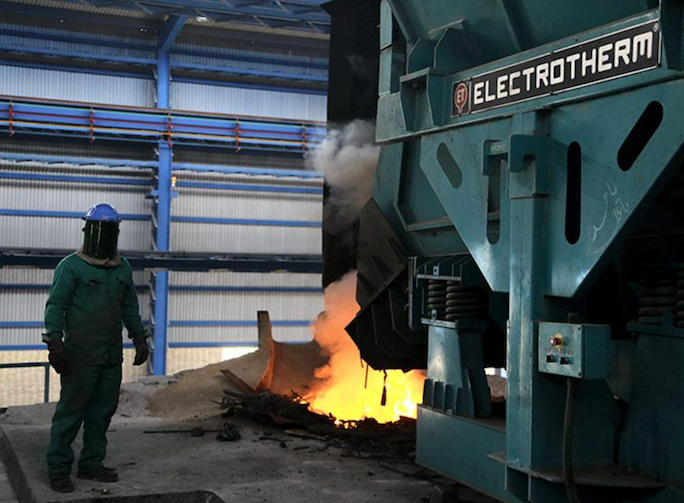
Some induction furnace installations use a dedicated sintering panel to share electrical load between an operating furnace and a newly lined crucible.
This arrangement may allow controlled preheating of the new lining while the main furnace continues its production operation.
The National Institute for Transforming India / UNDP mini-steel-plant compendium discusses this approach as an energy-efficiency measure. Its benefits depend on the furnace configuration and site-specific operating conditions.
Reference: Low-carbon Technology Packages for Mini Steel Plants: A Compendium.
11. Advantages of Silica-Based Ramming Mass
11.1 High-Temperature Capability
High-purity silica refractory systems can be designed for the high temperatures encountered in induction furnace melting.
The actual operating limit depends on the complete formulation and lining condition, not merely the SiO₂ percentage.
11.2 Good Thermal Shock Behaviour
Silica-based linings are widely used in coreless induction furnaces because their thermal expansion characteristics can be suitable for repeated heating and cooling when correctly formulated and operated.
11.3 Cost-Effectiveness
Silica ramming mass is often economically attractive compared with certain specialised neutral or basic refractory systems.
11.4 Availability of Raw Materials
Quartzite and silica-based raw materials are available through established industrial supply chains.
11.5 Suitable for Selected Ferrous Melting Operations
Silica linings are widely used in cast iron melting and selected mild-steel and low-alloy steel applications where slag chemistry is compatible.
12. Limitations of Silica Ramming Mass
Despite its advantages, silica ramming mass has important limitations.
12.1 Poor Resistance to Strongly Basic Slag
This is one of its major limitations.
Basic slag can react with silica and cause chemical corrosion.
12.2 Moisture Sensitivity
Moisture absorption during storage can affect material handling and installation behaviour.
Moisture also creates a safety concern during initial heating because trapped water can generate steam.
12.3 Sensitivity to Installation Quality
Uneven compaction, unsuitable particle grading and incorrect installation can result in weak zones and premature lining damage.
12.4 Thermal Expansion and Cracking
Silica undergoes polymorphic transformations that involve volume changes.
If the lining is heated or cooled too rapidly, thermal stresses can produce cracks or spalling.
12.5 Alloy-Specific Requirements
Certain alloy grades and slag practices may require neutral or basic refractories.
The refractory must be selected based on the actual metallurgical process rather than using one grade for all melting operations.
13. Common Causes of Premature Lining Failure
| Problem | Possible cause | Recommended investigation |
|---|---|---|
| Excessive sidewall erosion | Slag attack or high operating temperature | Analyse slag chemistry and operating temperature |
| Metal penetration | High porosity or weak sintering | Review grading, compaction and sintering |
| Vertical cracks | Thermal stress or installation defects | Inspect heating/cooling practice and lining construction |
| Localised hot spots | Uneven lining thickness or wear | Review shell-temperature trends and thickness mapping |
| Premature spalling | Moisture, thermal shock or weak bonding | Review storage, drying and first-heat schedule |
| Bottom wear | Mechanical impact, chemical attack or poor bottom construction | Inspect charging and bottom refractory practice |
| Collar damage | Charging and tapping abrasion | Review collar design and maintenance |
These symptoms can have multiple causes. Root-cause analysis should combine inspection, operating records, refractory analysis and furnace design review.
14. Monitoring and Maintenance of the Refractory Lining
Refractory management should be treated as a continuous operating activity.
Recommended monitoring practices include:
Record the number of heats in each lining campaign.
Monitor shell and coil-region temperatures.
Track specific energy consumption.
Observe metal penetration and slag-line erosion.
Inspect the lining during scheduled shutdowns.
Measure remaining thickness using approved methods.
Maintain records of repairs and patching.
Investigate abnormal power, cooling-water or temperature behaviour.
The lining should never be operated beyond the safe residual thickness defined by the furnace manufacturer and refractory engineering team.
15. Quality Control and Supplier Evaluation
A steel plant should evaluate ramming mass through both incoming-material inspection and actual furnace performance.
Recommended Quality-Control Checklist
| Parameter | What to verify |
|---|---|
| SiO₂ content | Chemical analysis and certificate |
| Al₂O₃, Fe₂O₃, CaO | Impurity limits |
| Particle-size distribution | Sieve analysis |
| Moisture | As-received moisture |
| Bulk density | Test result and consistency |
| Binder content | Formulation and batch consistency |
| Mineralogy | Quartzite characteristics and phase composition |
| Sintering behaviour | Product-specific test and supplier instructions |
| Packaging | Moisture-resistant and properly sealed |
| Traceability | Batch number and manufacturing date |
Questions to Ask the Supplier
What is the guaranteed SiO₂ percentage?
What is the complete chemical analysis?
What is the particle-size distribution?
Is the boron-based binder already incorporated?
What is the recommended sintering schedule?
What operating temperature range is supported by test data?
Is the material suitable for our exact steel or cast-iron grade?
What is the recommended lining thickness?
What is the expected performance under our slag conditions?
Can the supplier provide technical support during lining installation?
16. How to Improve Lining Life in an Induction Furnace
Longer refractory campaign life is achieved through a combination of material quality, installation discipline and operating control.
The following practices are particularly important:
Material selection
Select the refractory based on metal and slag chemistry.
Use consistent, high-purity raw materials.
Verify particle grading and binder concentration.
Installation
Prepare the furnace correctly.
Ensure uniform compaction.
Maintain consistent lining thickness.
Avoid contamination and moisture.
Sintering
Follow the approved first-heat schedule.
Monitor heating conditions.
Avoid uncontrolled thermal shock.
Production
Control charging practices.
Avoid excessive operating temperatures.
Maintain appropriate slag chemistry.
Control unnecessary slag exposure and mechanical abrasion.
Monitor lining wear and shell temperatures.
Maintenance
Maintain campaign records.
Repair the lining according to approved procedures.
Investigate abnormal wear rather than simply increasing refractory consumption.
17. Economic Importance of Ramming Mass Management
Ramming mass is a recurring operating cost.
However, the lowest purchase price does not necessarily produce the lowest cost per tonne of liquid metal.
A better comparison is the refractory cost per tonne of production.
Formula:
Refractory cost per tonne of liquid metal:
= Total lining material and installation cost ÷ Total tonnes melted during the campaign
For example:
| Parameter | Illustrative value |
|---|---|
| Total lining and installation cost | ₹1,50,000 |
| Total metal melted during campaign | 3,000 tonnes |
| Refractory cost per tonne | ₹50/tonne |
This is an illustrative calculation, not a market quotation.
A refractory that costs more per bag may still be economically superior if it delivers longer campaign life, fewer shutdowns and more stable operation.
Other important costs include:
Furnace downtime.
Labour and installation expenses.
Energy consumed during sintering.
Production losses.
Emergency repair costs.
Risk associated with refractory failure.
18. Conclusion
Silica-based ramming mass is an essential refractory material in many coreless induction furnace installations.
Its performance is determined by the combined effect of silica purity, mineralogical characteristics, particle-size distribution, boron-based sintering additives, installation quality, sintering procedure and operating conditions.
For steel manufacturers, refractory selection should always be based on actual melting practice and slag chemistry.
A properly selected and installed silica lining can provide reliable service, good thermal performance and economical furnace operation in suitable applications.
However, silica ramming mass is not universally suitable for all steel grades and slag conditions. For operations involving strongly basic slags or specific alloy requirements, neutral or basic refractory systems should also be evaluated.
The key to longer lining life is not simply buying better ramming mass. It is controlling the complete refractory management cycle—from raw-material selection to final furnace operation.
References and Further Reading
IspatGuru – Refractory Lining of Coreless Induction Furnace. https://www.ispatguru.com/refractory-lining-of-coreless-induction-furnace/
IspatGuru – Induction Furnace Refractory Lining with Silica Ramming Mass. https://www.ispatguru.com/induction-furnace-refractory-lining-with-silica-ramming-mass/
IntechOpen – Refractories for the Cast Iron Melting. https://www.intechopen.com/chapters/82718
Saint-Gobain – How to Extend Refractory Lining Life in Coreless Induction Furnaces. https://www.ceramicsrefractories.saint-gobain.com/news-articles/how-extend-refractory-lining-life-coreless-induction-furnaces
NITI Aayog / UNDP – Low-carbon Technology Packages for Mini Steel Plants: A Compendium.
Mahavir Industries – Silica Ramming Mass: Typical Technical Parameters. https://www.mahavir-india.com/products/sili_ram_mass.htm
Engineering note: All indicative composition ranges, particle grading and performance descriptions must be checked against the specific manufacturer's technical data sheet. Installation, drying and sintering instructions must be product- and furnace-specific. This article is intended for technical education and does not replace an approved refractory installation procedure.
METATECHX ENGINEERS
Engineering Consultancy | Steel Plant Solutions | Operations & Maintenance | Industrial Skill Development
Comments 0
Be the first to share your thoughts.
Leave a comment
Your comment will appear after a quick moderation check.