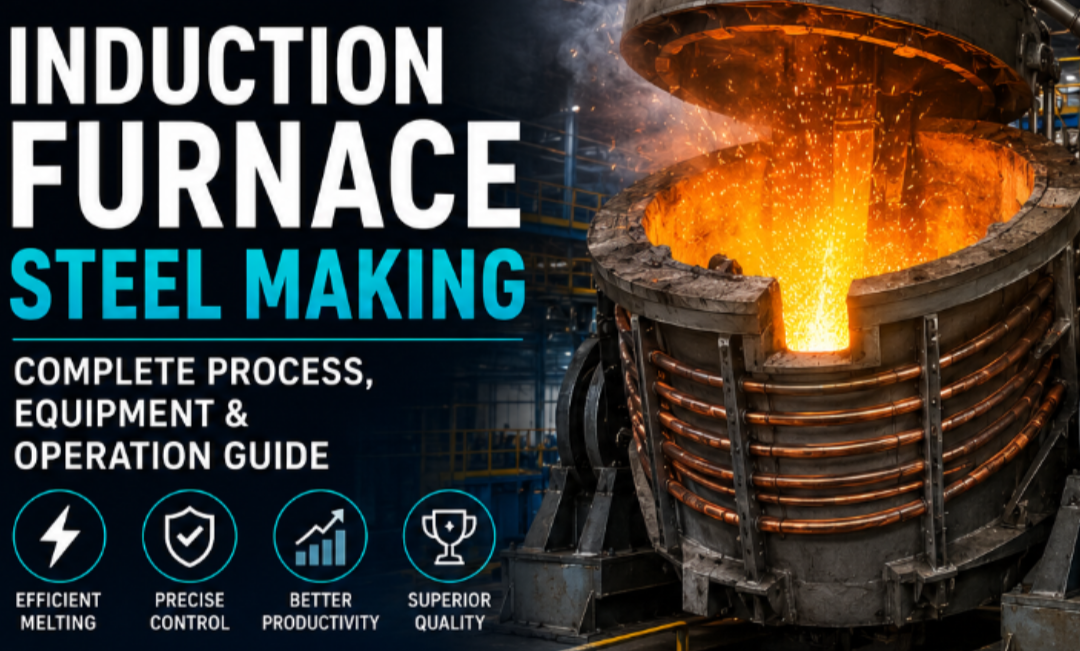
Induction furnace steel making is one of the most widely used methods for melting steel and producing liquid metal from scrap, returns, DRI, pig iron, and other metallic inputs.
Induction furnaces are used extensively in steel plants, foundries, mini-steel plants, and secondary steelmaking facilities because they provide relatively clean melting, accurate temperature control, flexible charge-mix operation, and good production control.
However, efficient induction furnace operation requires much more than simply melting scrap. The operator must understand charge preparation, furnace loading, electrical power, melting behavior, slag formation, temperature control, alloy additions, chemical composition, refractory condition, cooling-water systems, hydraulic equipment, and tapping practices.
This complete guide explains the induction furnace steel making process, major equipment, electrical systems, operating practices, maintenance requirements, common problems, and safety considerations.
What Is an Induction Furnace?
An induction furnace is an electrically powered melting furnace that uses electromagnetic induction to generate heat inside the metallic charge.
Unlike fuel-fired furnaces, the metal is heated primarily through electromagnetic energy generated by the furnace coil.
The basic principle is:
Electrical Power → Magnetic Field → Induced Current in Metal → Heat → Melting
The furnace coil carries alternating current. This produces a changing magnetic field around the charge. The changing magnetic field induces electrical currents within the metal, generating heat and causing the charge to melt.
Induction Furnace Steel Making Process
A typical induction furnace steelmaking sequence is:
Raw Material Selection
↓
Charge Preparation
↓
Furnace Inspection
↓
Charging
↓
Power ON
↓
Melting
↓
Slag Formation
↓
Slag Removal
↓
Temperature Measurement
↓
Chemical Analysis
↓
Alloy Addition
↓
Final Temperature & Chemistry Adjustment
↓
Tapping
↓
Furnace Cleaning / Inspection
↓
Next Heat
Each stage affects productivity, steel quality, energy consumption, and furnace life.
1. Raw Materials for Induction Furnace Steel Making
The quality of the metallic charge has a major influence on the final steel.
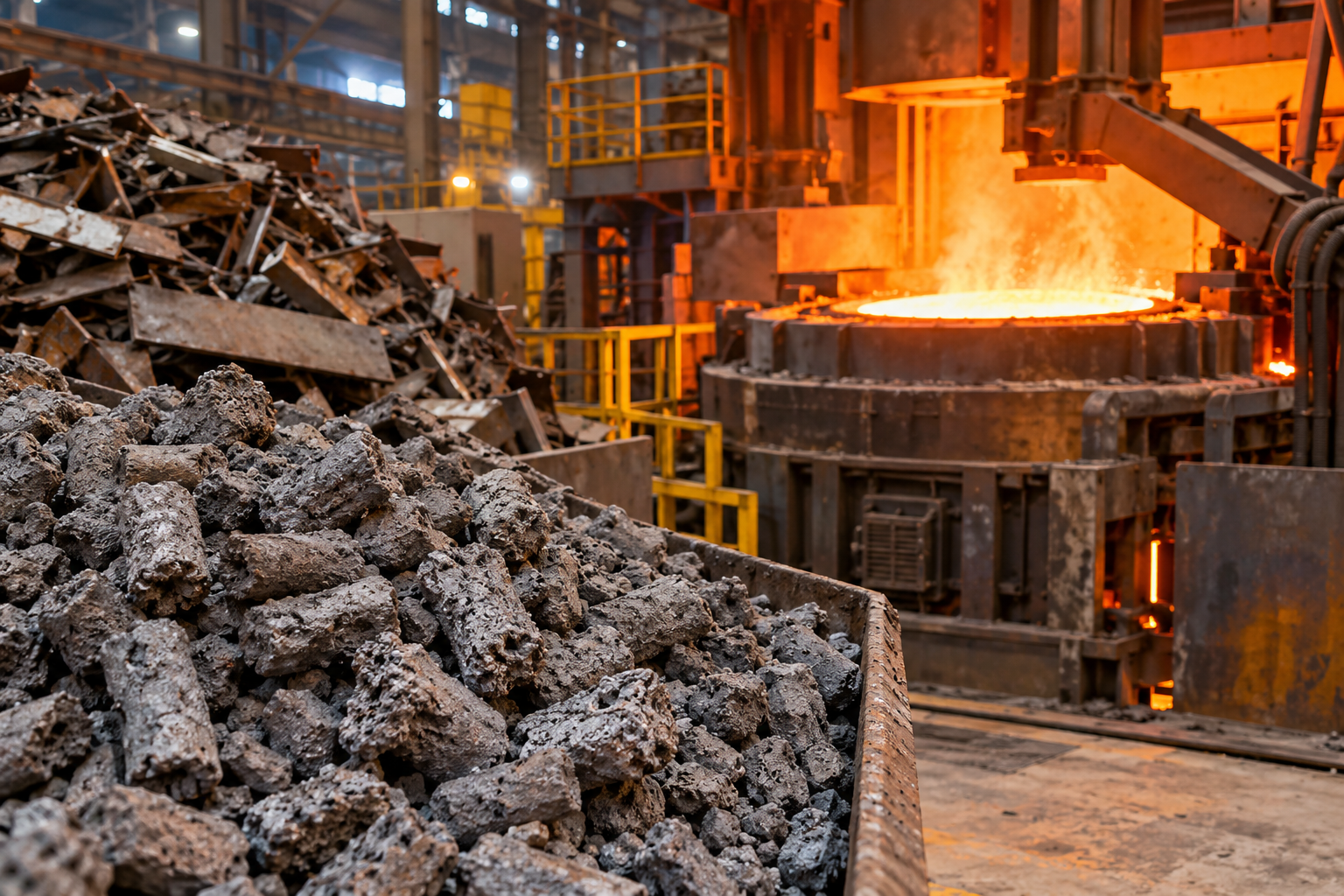
Common charge materials include:
- Steel scrap
- Heavy melting scrap
- Light melting scrap
- MS scrap
- Industrial returns
- Foundry returns
- DRI
- HBI
- Pig iron
- Recycled steel
- Ferroalloys
The actual charge mix depends on the required steel grade, available raw materials, furnace capacity, production cost, and metallurgical requirements.
2. Charge Mix
Charge mix means the planned combination of different metallic materials used for producing a particular heat.
For example, a charge may contain a controlled combination of:
Scrap + DRI + Pig Iron + Returns
The objective is to achieve:
- Required chemical composition
- Desired carbon level
- Controlled impurities
- Good melting performance
- Acceptable slag volume
- Low metallic loss
- Economical production
Important elements that may require control include:
- Carbon
- Silicon
- Manganese
- Sulphur
- Phosphorus
- Chromium
- Nickel
- Molybdenum
The charge mix should be designed according to the target steel grade rather than simply selecting the cheapest available material.
3. Scrap Inspection and Preparation
Before charging, scrap should be inspected carefully.
Operators should look for:
- Excessive rust
- Oil contamination
- Closed containers
- Explosive materials
- Non-metallic materials
- Excessive moisture
- Large oversized pieces
- Copper contamination
- Zinc-coated material
- Unknown materials
Why scrap preparation matters
Improper scrap can cause:
- Explosion hazards
- Excessive slag
- Uncontrolled chemistry
- Reduced productivity
- Increased electrode or refractory problems
- Higher energy consumption
- Furnace damage
Never charge wet, sealed, or potentially hazardous material without following the plant's approved safety procedure.
4. Furnace Inspection Before Charging
Before starting a heat, the operator and maintenance team should inspect the furnace.
Important inspection points include:
Refractory
Check for:
- Cracks
- Erosion
- Local thinning
- Loose material
- Previous penetration
- Abnormal wear
Furnace Coil
Check for:
- Cooling-water flow
- Leakage
- Hose condition
- Coil insulation
- Ground-fault protection
- Abnormal temperature
Furnace Tilting System
Inspect:
- Hydraulic cylinders
- Hydraulic pressure
- Oil leakage
- Mechanical linkages
- Limit switches
Electrical System
Check:
- Power supply
- Converter/inverter
- Capacitor bank
- Busbars
- Earthing
- Protection systems
- Cooling systems
5. Furnace Charging
Correct charging is critical for safe and efficient melting.
The charge should be loaded in a controlled sequence appropriate for the furnace design and charge materials.
The objective is to:
- Avoid bridging
- Protect the refractory
- Maintain good electromagnetic coupling
- Reduce charging time
- Minimize damage to the furnace
- Achieve smooth melting
Oversized scrap can create bridging inside the furnace.
What Is Bridging?
Bridging occurs when charge material forms a structure across the furnace rather than settling properly.
This can result in:
- Poor melting below the bridge
- Unstable metal movement
- Sudden collapse of the charge
- Splashing
- Mechanical damage
- Operational safety hazards
Operators must follow the furnace manufacturer's and plant's approved charging practice.
6. Starting the Melting Process
Once charging is complete or an appropriate initial charge has been loaded, electrical power is applied.
The induction system generates a magnetic field around the furnace.
Electrical currents induced in the metal generate heat.
As the charge begins melting:
- Solid scrap collapses
- Liquid metal forms
- Electromagnetic stirring increases
- Heat transfer improves
- Additional charge can be added
Power input is controlled according to furnace conditions and the operating procedure.
7. Electromagnetic Stirring
One major advantage of induction melting is electromagnetic stirring.
The electromagnetic field creates movement within the molten metal.
This helps:
- Improve heat transfer
- Promote temperature uniformity
- Improve chemical mixing
- Reduce localized overheating
- Assist dissolution of additions
However, excessive turbulence can also increase metal/slag interaction and potentially contribute to oxidation or refractory wear.
Therefore, power and operating conditions must be controlled appropriately.
8. Melting Stage
During melting, the operator continuously observes the furnace.
Typical parameters include:
- Furnace power
- Voltage
- Current
- Frequency
- Metal temperature
- Cooling-water temperature
- Cooling-water flow
- Furnace tilt position
- Hydraulic pressure
- Charge condition
As the solid charge becomes molten, operators may add additional charge material.
The objective is to maintain stable melting while minimizing:
- Energy consumption
- Melting time
- Metal oxidation
- Slag generation
- Refractory wear
9. Slag Formation
Slag forms from oxidized elements, gangue, fluxes, refractory interaction, and other non-metallic materials.
Slag may contain compounds involving:
- Calcium oxide
- Silicon oxide
- Iron oxide
- Manganese oxide
- Aluminium oxide
- Magnesium oxide
- Other constituents
The exact slag practice depends on the steel grade and process.
Good slag management is important for:
- Removing unwanted impurities
- Protecting the molten steel
- Controlling oxidation
- Reducing metal loss
- Supporting metallurgical reactions
10. Slag Removal
Slag should be removed according to the plant's metallurgical practice.
Excessive slag can:
- Reduce metal yield
- Increase material consumption
- Carry valuable metal out of the furnace
- Interfere with chemistry control
- Affect tapping
Insufficient slag management can also affect steel quality.
The operator therefore needs to maintain an appropriate slag condition rather than simply trying to minimize slag quantity.
11. Temperature Measurement
Temperature control is one of the most important parts of steelmaking.
Temperature may be measured using:
- Immersion thermocouples
- Disposable thermocouples
- Optical pyrometers
- Other approved temperature-measurement systems
The target temperature depends on:
- Steel grade
- Tapping practice
- Casting temperature
- Ladle temperature loss
- Downstream process requirements
The furnace should not simply be overheated "for safety." Excessive temperature can increase:
- Energy consumption
- Oxidation
- Refractory wear
- Metal loss
12. Chemical Analysis
Before tapping, a sample may be taken for chemical analysis.
Depending on the plant laboratory and process, analysis may include:
- Carbon
- Silicon
- Manganese
- Sulphur
- Phosphorus
- Chromium
- Nickel
- Other alloying elements
The actual testing method depends on the plant's laboratory and quality-control system.
The measured chemistry is compared with the required grade specification.
13. Alloy Addition
If chemical adjustment is required, appropriate ferroalloys or alloying materials may be added.
Common additions can include:
- Ferro manganese
- Ferro silicon
- Silicon manganese
- Ferro chromium
- Nickel
- Carbon raiser
- Aluminium
- Other grade-specific additions
Additions should be made according to the approved metallurgical procedure and calculated requirement.
Over-addition can be expensive and may cause the composition to exceed specification.
14. Carbon Adjustment
Carbon is a critical element in steel.
Carbon adjustment may be required when the initial charge does not provide the required carbon level.
Carbon-bearing materials may be used according to the steel grade and plant practice.
The calculation should consider:
- Existing carbon in the melt
- Target carbon
- Metal quantity
- Recovery efficiency
- Addition composition
Actual recovery varies with operating conditions and should be established from plant data.
15. Deoxidation
Molten steel can contain dissolved oxygen.
Deoxidation practices are used to reduce dissolved oxygen and control steel cleanliness according to the required grade and downstream process.
Materials such as aluminium, silicon, or manganese-containing additions may be involved depending on the grade and process route.
Deoxidation practice must be controlled carefully because excessive additions can affect inclusions and final chemistry.
16. Tapping
When the steel reaches the required:
- Temperature
- Chemical composition
- Metallurgical condition
the heat is tapped into the ladle.
During tapping, the operator should control:
- Furnace tilting
- Metal stream
- Slag carryover
- Ladle position
- Tapping sequence
Minimizing unwanted slag carryover is important for downstream steel quality.
17. Ladle Handling
After tapping, the ladle is transported for the next stage.
Depending on the plant configuration, the liquid steel may proceed to:
Ladle → Continuous Casting Machine
or
Ladle → Secondary Metallurgy → Continuous Casting
The downstream route depends on the product and required steel quality.
Major Equipment in an Induction Furnace Plant
A modern induction furnace installation may include:
- Induction Furnace
- Furnace Coil
- Power Supply System
- Converter/Inverter
- Capacitor Bank
- Busbars
- Water Cooling System
- Hydraulic Tilting System
- Furnace Refractory
- Charging System
- Fume Extraction System
- Slag Handling System
- Temperature Measurement System
- Spectrometer/Laboratory System
- Ladle and Ladle Handling System
- PLC and Automation System
- Safety Protection System
Induction Furnace Electrical System
The electrical system is one of the most critical parts of the furnace.
A simplified system can be represented as:
Incoming Power
↓
Transformer
↓
Rectifier / Converter
↓
Inverter
↓
Capacitor / Resonant Circuit
↓
Furnace Coil
↓
Electromagnetic Field
↓
Metal Heating
The exact configuration varies by furnace manufacturer and design.
Furnace Coil
The furnace coil is normally made from water-cooled copper tubing.
Its functions include:
- Generating the electromagnetic field
- Transferring electrical energy into the metallic charge
- Supporting efficient induction heating
Because the coil carries high electrical current and requires continuous cooling, its condition is critical.
Coil problems can be extremely serious.
Operators should monitor:
- Cooling-water flow
- Water temperature
- Pressure
- Leakage
- Insulation condition
- Ground protection
Cooling-Water System
The induction furnace coil requires reliable cooling.
A typical cooling system can include:
- Water pumps
- Heat exchanger
- Cooling tower or closed-loop cooling system
- Expansion tank
- Filters
- Flow meters
- Pressure sensors
- Temperature sensors
- Emergency cooling arrangements
Loss of cooling can rapidly create dangerous operating conditions.
Therefore, cooling-water protection and alarms should never be bypassed without an approved procedure.
Hydraulic Tilting System
The furnace is generally tilted hydraulically for:
- Slag removal
- Tapping
- Furnace cleaning
- Operational positioning
A hydraulic system can contain:
- Hydraulic pump
- Motor
- Oil tank
- Directional valves
- Pressure-relief valve
- Hydraulic cylinders
- Hoses
- Accumulator
- Limit switches
Hydraulic leakage, low pressure, or cylinder malfunction can affect furnace operation.
Furnace Refractory
The refractory lining protects the furnace structure and coil from molten metal.
Typical refractory systems may contain specially selected materials suitable for induction melting.
The refractory must withstand:
- High temperature
- Thermal cycling
- Mechanical impact
- Chemical attack
- Electromagnetic stirring
Refractory wear must be monitored carefully.
A damaged refractory lining can lead to molten-metal penetration and potentially severe equipment damage.
PLC and Automation
Modern induction furnace plants increasingly use PLC-based automation.
PLC systems can monitor and control:
- Furnace operation
- Hydraulic systems
- Cooling-water systems
- Pumps
- Valves
- Alarms
- Interlocks
- Charging equipment
- Tilting systems
Instrumentation may include:
- Temperature sensors
- Pressure transmitters
- Flow switches
- Level sensors
- Position sensors
- Current transformers
- Voltage measurement
- Water-temperature sensors
Important Furnace Interlocks
Safety interlocks can protect equipment and personnel by preventing unsafe operation.
Depending on furnace design, interlocks may monitor:
- Cooling-water flow
- Cooling-water temperature
- Hydraulic pressure
- Furnace position
- Electrical faults
- Earth leakage
- Door or access conditions
- Emergency-stop conditions
Interlocks should never be bypassed simply to keep production running.
Any modification should follow the plant's approved electrical, automation, and safety-management procedures.
Common Induction Furnace Problems
1. Furnace Not Taking Full Power
Possible causes may include:
- Electrical system fault
- Cooling problem
- Converter/inverter issue
- Capacitor problem
- Poor charge coupling
- Protection-system activation
The exact cause should be diagnosed using the manufacturer's troubleshooting procedure.
2. Excessive Slag
Possible contributing factors include:
- High-oxidation charge materials
- Excessive flux addition
- Poor charge quality
- Improper melting practice
- High oxidation losses
3. Excessive Refractory Wear
Possible causes include:
- Incorrect refractory selection
- Poor lining practice
- Excessive temperature
- Aggressive slag
- Mechanical impact
- Improper furnace operation
4. Cooling-Water Temperature Rising
Possible causes include:
- Reduced flow
- Heat-exchanger fouling
- Pump problems
- Cooling-tower problems
- Blocked filters
- Excessive thermal load
This condition requires prompt attention because coil cooling is critical to furnace safety.
5. Hydraulic Tilting Problem
Possible causes include:
- Low hydraulic pressure
- Pump failure
- Valve malfunction
- Cylinder leakage
- Hose failure
- Position-sensor problem
Energy Efficiency in Induction Furnace Operation
Energy consumption is a major operating cost.
Energy efficiency can be improved through:
- Proper charge preparation
- Correct charge mix
- Reduced charging time
- Efficient furnace loading
- Proper power management
- Minimizing unnecessary overheating
- Good refractory condition
- Effective cooling-system operation
- Preventive maintenance
- Reduction of unnecessary holding time
One important principle is:
The fastest melt is not always the most efficient melt.
Stable operation with good charge preparation and controlled power input can produce better overall efficiency.
Preventive Maintenance Checklist
Daily Checks
Inspect:
- Cooling-water flow
- Water temperature
- Hydraulic pressure
- Oil leakage
- Furnace condition
- Refractory condition
- Electrical alarms
- Abnormal noise
- Abnormal vibration
- Furnace coil condition
Periodic Checks
Inspect:
- Pumps
- Valves
- Hydraulic cylinders
- Cooling-water pipelines
- Heat exchangers
- Capacitors
- Electrical connections
- Busbars
- Transformer
- Converter/inverter
- Sensors
- PLC panels
Maintenance intervals should follow equipment manufacturer recommendations and the plant's maintenance strategy.
Electrical Maintenance
Electrical maintenance teams should pay particular attention to:
- Transformer condition
- Converter/inverter
- Capacitor bank
- Busbars
- Power cables
- Earthing
- Protection systems
- Cooling systems
- Electrical panel ventilation
- Insulation
- Loose connections
Thermal scanning, insulation testing, connection inspection, and other condition-monitoring techniques can help identify developing faults when performed under an approved maintenance program.
Mechanical Maintenance
Mechanical teams should inspect:
- Furnace structure
- Hydraulic cylinders
- Bearings
- Tilting mechanism
- Ladle handling system
- Charging equipment
- Pumps
- Valves
- Pipelines
- Fume extraction equipment
Early detection of mechanical deterioration can prevent major downtime.
Safety in Induction Furnace Steel Making
Induction furnace operations involve several major hazards:
- Molten metal
- High temperature
- High electrical energy
- Water near molten metal
- Hydraulic pressure
- Heavy lifting
- Fumes and dust
- Refractory failure
- Scrap-related explosions
Important safety practices include:
- Use appropriate PPE
- Keep moisture away from molten metal
- Inspect scrap before charging
- Follow lockout/tagout procedures
- Maintain electrical protection
- Maintain cooling-water protection
- Never bypass safety interlocks
- Maintain safe working distances
- Follow approved tapping procedures
- Maintain emergency-response systems
Plant-specific SOPs, risk assessments, OEM instructions, and applicable regulations must take precedence over any general guidance.
How to Improve Induction Furnace Productivity
A systematic improvement program should focus on:
1. Reduce Charging Time
Better scrap preparation and charging organization can reduce non-productive time.
2. Optimize Charge Mix
Use a controlled charge mix that supports both chemistry and melting efficiency.
3. Control Tapping Temperature
Avoid unnecessary overheating.
4. Reduce Holding Time
Once the heat meets the required conditions, coordinate efficiently with downstream operations.
5. Maintain Furnace Refractory
Good refractory condition improves reliability and reduces unplanned stoppages.
6. Maintain Cooling Systems
Reliable cooling protects the coil and electrical equipment.
7. Analyze Heat Data
Track:
- kWh per tonne
- Melting time
- Tap-to-tap time
- Metallic yield
- Slag generation
- Alloy consumption
- Downtime
- Temperature
- Chemistry deviations
Data-driven monitoring can reveal opportunities for continuous improvement.
Important KPIs for an Induction Furnace
Steel plants can track several key performance indicators.
Energy Consumption
kWh per tonne of liquid steel
Productivity
Tonnes per hour
Tap-to-Tap Time
Time required to complete one heat cycle.
Metallic Yield
The percentage of metallic input converted into usable steel.
Refractory Life
Number of heats achieved per lining.
Furnace Availability
Percentage of scheduled time that the furnace is available for production.
Downtime
Time lost because of:
- Electrical faults
- Mechanical failures
- Refractory problems
- Hydraulic failures
- Cooling-system problems
- Production delays
Practical Knowledge Every Induction Furnace Operator Should Have
An experienced operator should understand:
- Charge mix
- Scrap quality
- Furnace capacity
- Power behavior
- Melting characteristics
- Slag behavior
- Temperature measurement
- Chemical analysis
- Alloy additions
- Tapping
- Refractory condition
- Cooling system
- Hydraulic system
- Electrical alarms
- Furnace safety
- Emergency procedures
The operator should also understand the difference between a normal process variation and an abnormal equipment condition.
Induction Furnace: Operation vs Maintenance
Successful furnace performance requires close cooperation between departments.
| Area | Operation Team | Maintenance Team |
|---|---|---|
| Melting | Controls process | Supports equipment |
| Temperature | Monitors and adjusts | Maintains instruments |
| Chemistry | Controls additions | Supports analysis equipment |
| Refractory | Monitors condition | Supports lining work |
| Electrical | Observes alarms | Maintains electrical system |
| Hydraulic | Monitors pressure | Maintains pumps/valves/cylinders |
| Cooling | Monitors flow/temp | Maintains pumps and heat exchangers |
| Automation | Uses HMI/PLC system | Maintains PLC/instruments |
| Safety | Follows SOP | Maintains protection systems |
The best results come when operations, mechanical maintenance, electrical maintenance, automation, quality, and safety teams work together.
Frequently Asked Questions
What is an induction furnace used for?
An induction furnace is primarily used to melt metallic materials using electromagnetic induction. In steel plants it can be used to melt scrap, DRI, pig iron, returns, and other metallic charge materials.
What is the basic principle of an induction furnace?
An alternating current in the furnace coil creates a changing magnetic field. This induces electrical currents in the metal, producing heat and melting the charge.
What are the main components of an induction furnace?
Major components include the furnace body, refractory lining, copper coil, power supply, converter/inverter, capacitor or resonant circuit, cooling system, hydraulic tilting system, control system, and safety protection.
Why is cooling water important?
The furnace coil and other equipment can generate substantial heat. Reliable cooling is essential for protecting the coil and maintaining safe operation.
What is charge mix?
Charge mix is the planned combination of metallic raw materials used to produce a particular steel grade.
Why is slag important?
Slag participates in controlling impurities and oxidation and can protect the molten steel. However, excessive or poorly controlled slag can increase metal loss and affect process efficiency.
What is tap-to-tap time?
Tap-to-tap time is the elapsed time between successive tapping operations and is an important productivity indicator.
How can induction furnace energy consumption be reduced?
Energy consumption can be improved through good charge preparation, optimized charge mix, efficient furnace loading, controlled power input, reduced unnecessary holding and overheating, good refractory condition, and preventive maintenance.
MetaTechX: Build Practical Steel Industry Skills
Understanding an induction furnace is not only about knowing its components.
A competent steel-industry professional should be able to connect:
Process + Equipment + Electrical + Automation + Maintenance + Safety
That combination of knowledge is what makes technical professionals valuable in modern steel plants.
MetaTechX GetCertified is designed to assess professional knowledge in practical industrial areas including:
- Steel Plant Operations
- Electrical & Automation
- Mill Equipment & Maintenance
- Industrial Equipment
- Technical Troubleshooting
Assess Your Professional Skills
ASSESS. CERTIFY. GET RECOGNIZED. GET PREFERRED.
Explore MetaTechX GetCertified and evaluate your professional technical knowledge.
Conclusion
Induction furnace steel making is a carefully controlled combination of electrical energy, electromagnetic heating, metallurgy, equipment operation, temperature control, chemistry control, refractory management, and safety.
From selecting the right charge mix to controlling the final tapping temperature, every stage can influence steel quality, productivity, energy consumption, and equipment life.
For operators, engineers, electricians, automation professionals, and maintenance technicians, understanding the complete process provides a major advantage when troubleshooting problems and improving plant performance.
A modern steel plant needs professionals who don't just know what a machine does, but understand why it behaves the way it does and how it interacts with the complete production process.
That is the foundation of practical industrial expertise.
MetaTechX Technical Learning Series
Steel Making | Induction Furnace | Hot Rolling | Mill Equipment | Electrical | Automation | Maintenance | Operations | Industrial Skills
Follow MetaTechX for practical technical knowledge, engineering insights, and professional skill development.
Comments 0
Be the first to share your thoughts.
Leave a comment
Your comment will appear after a quick moderation check.