
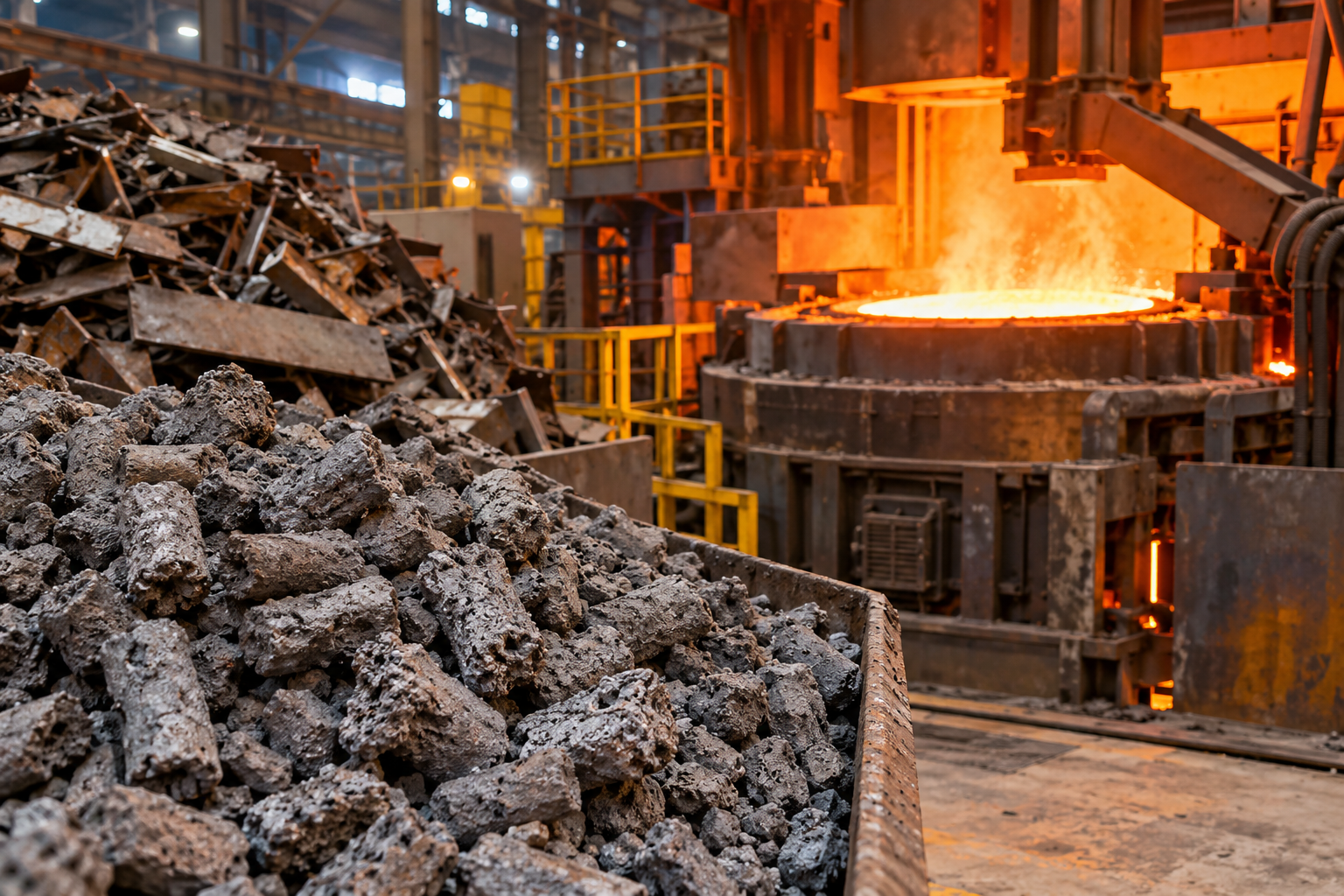
Influence of FeO in Sponge Iron (DRI) During Steel Melting: Chemical Reactions, Slag Formation, Energy Consumption and Steel Quality
Published by: MetaTechX LLP
Category: Steel Making | Metallurgy | Induction Furnace | Sponge Iron | Steel Melt Shop
1. Introduction
Sponge iron, also known as Direct Reduced Iron (DRI), is an important metallic charge material used in steelmaking, particularly in induction furnace-based steel melt shops. It is produced by removing oxygen from iron ore in the solid state, generally using a reducing gas or carbonaceous reductant.
Although the reduction process converts iron oxides into metallic iron, commercial sponge iron normally retains a certain amount of unreduced iron oxide, principally wüstite (FeO), along with gangue, residual carbon and other impurities.
The FeO content of sponge iron is a critical metallurgical parameter because it influences metallic yield, slag generation, carbon consumption, electrical energy requirements, bath chemistry and the cleanliness of the final steel.
In an induction furnace, these effects become particularly important because the furnace primarily supplies energy through electromagnetic induction. Unlike an oxygen steelmaking converter, a conventional induction furnace does not normally rely on a dedicated oxygen-blowing system to provide large quantities of chemical heat.
Consequently, the quality of the DRI charge, the amount of FeO entering the bath, the carbon available for reduction, the slag composition and the operating practice collectively determine the efficiency of melting.
The key principle is that FeO is both a source of iron and a source of oxygen. Recovering the iron requires reducing the oxide, while the associated oxygen can oxidize carbon, silicon, manganese and other oxidizable elements.
Understanding this balance helps steelmakers improve metallic recovery, reduce avoidable energy consumption and maintain consistent steel chemistry.
2. What Is FeO in Sponge Iron?
Iron ore contains iron oxides, primarily hematite (Fe₂O₃) and magnetite (Fe₃O₄). During direct reduction, these oxides are progressively converted into metallic iron.
A simplified representation of the reduction sequence is:
Fe₂O₃ → Fe₃O₄ → FeO → Fe
The actual reaction pathway depends on temperature, reducing-gas composition, oxygen potential and the characteristics of the ore.
When reduction is incomplete, some FeO remains in the sponge iron.
The FeO content is commonly associated with the degree of metallization of DRI. However, FeO content, total iron content and metallization are different parameters and should not be used interchangeably.
Important DRI quality parameters
Total iron (FeT): The total iron present in the material, including iron in metallic and oxidized forms.
Metallic iron (FeM): The iron present in the metallic state.
Degree of metallization: The proportion of total iron present as metallic iron.
Residual FeO: Iron oxide remaining after the reduction process.
Gangue: Non-metallic constituents such as silica (SiO₂), alumina (Al₂O₃) and other mineral oxides.
Residual carbon: Carbon retained in the DRI after reduction.
The degree of metallization is calculated as:
Degree of metallization (%) = (Metallic iron / Total iron) × 100
A higher degree of metallization generally means a lower proportion of iron remains in oxidized form. Nevertheless, two DRI lots with similar metallization can have different gangue compositions, residual carbon levels and melting behavior.
For reliable process control, steelmakers should evaluate the complete DRI chemical analysis rather than FeO alone.
3. Major Chemical Reactions of FeO During Steel Melting
Once sponge iron enters the molten bath, its remaining iron oxide can participate in several reactions. The dominant reactions depend on the bath temperature, carbon content, slag composition, contact between the metal and slag, and the availability of reducing agents.
3.1 Reduction of FeO by Carbon
One of the most important reactions is:
FeO + C → Fe + CO↑
In this reaction, carbon removes oxygen from FeO, producing metallic iron and carbon monoxide gas.
The reaction can be represented in two stages.
First, oxygen is transferred from FeO to carbon, potentially through dissolved oxygen or an oxide–metal interfacial reaction.
Second, carbon monoxide forms and leaves the reaction zone as gas.
At steelmaking temperatures, the reaction can be favored by appropriate carbon activity, temperature and low CO partial pressure. However, the actual reaction rate depends strongly on interfacial contact and slag properties.
Effects on steelmaking
1. Metallic iron recovery
Successful reduction converts iron oxide into metallic iron, improving iron recovery.
2. Carbon consumption
Carbon is consumed in reducing the oxide. If the carbon requirement is underestimated, the final carbon content may fall below the target.
3. CO generation
Carbon monoxide can form bubbles in the bath or slag. Depending on conditions, these bubbles may promote mixing but can also cause foaming, splashing or excessive slag movement.
4. Thermal demand
The reduction of FeO by carbon through CO formation is generally endothermic under typical steelmaking conditions. It therefore consumes thermal energy rather than providing a dependable source of heat.
This is an important distinction: the oxidation of carbon by oxygen is exothermic, but the overall reduction of iron oxide by carbon to produce CO requires energy under standard steelmaking conditions.
The net thermal effect in an operating furnace also includes sensible heat, dissolution, mixing and other chemical reactions.
3.2 Oxidation of Carbon by FeO-Derived Oxygen
FeO can supply oxygen that reacts with carbon in the molten metal.
A useful representation is:
[O] + [C] → CO↑
Here, [O] represents dissolved oxygen in the molten steel.
This reaction is different from the direct reaction written as FeO + C → Fe + CO, although both can describe related stages of oxygen transfer and reduction.
Carbon oxidation can influence the bath in several ways:
Reduces dissolved oxygen when carbon and oxygen react successfully.
Changes the carbon content of the molten steel.
Generates CO gas and may contribute to bath agitation.
Can contribute to gas-related defects if gas generation and escape are poorly controlled.
May reduce metallic yield if oxide reduction is incomplete and iron remains in the slag.
Carbon oxidation is not automatically harmful. Its effect depends on the target steel grade, initial carbon level, oxygen balance and operating conditions.
For example, a bath with excessive carbon may benefit from controlled carbon oxidation. Conversely, a low-carbon grade may require careful management to prevent carbon from falling below the specified limit.
3.3 Reaction of FeO with Silicon
Silicon has a strong affinity for oxygen. Dissolved silicon can react with FeO in the slag:
[Si] + 2(FeO) → (SiO₂) + 2Fe
The square brackets indicate elements dissolved in the metal, while parentheses indicate species in the slag.
This reaction transfers silicon from the metal into silica and returns iron to the metallic phase.
The silica formed can then participate in slag-forming reactions with CaO, MgO and other oxides.
Operational implications
Silicon content in the bath may decrease.
Additional silica enters the slag.
The slag's basicity and viscosity can change.
The amount of flux required to achieve the desired slag condition may change.
Oxidation of silicon represents a chemical loss of a valuable alloying element when silicon retention is desired.
The extent of silicon oxidation depends on the initial silicon content, oxygen potential and metal–slag equilibrium.
3.4 Reaction of FeO with Manganese
Manganese can also reduce FeO:
[Mn] + (FeO) → (MnO) + Fe
This reaction produces manganese oxide in the slag and metallic iron.
Manganese oxidation can reduce the manganese content of the steel and increase the oxide load in the slag.
If manganese must be retained in the final grade, excessive oxidation can increase alloy addition requirements. The actual manganese recovery depends on slag chemistry, temperature and the timing of alloy additions.
3.5 Reaction with Calcium Oxide (CaO)
Calcium oxide is a major component of steelmaking slag and is commonly introduced through lime or formed during the decomposition of limestone.
A simplified representation of the interaction between FeO and CaO is:
(FeO) + (CaO) ⇌ (CaO–FeO-containing slag)
This notation describes a mixed oxide slag, not necessarily a single, discrete chemical compound.
CaO does not simply eliminate FeO from the system. Instead, it affects the slag's chemical activity, phase composition, liquidus temperature and interaction with other oxides.
In an appropriate slag system, CaO can help establish a slag condition suitable for impurity control and metal–slag separation. However, the actual behavior depends on the complete slag composition.
Important: Adding more lime does not automatically reduce FeO or guarantee lower energy consumption. Excessive lime can increase slag quantity, produce undissolved solids and worsen slag fluidity if the composition and temperature are unsuitable.
3.6 Reaction with Silica (SiO₂)
FeO and silica can combine within an oxide slag.
A simplified representation is:
(FeO) + (SiO₂) ⇌ iron-silicate-containing slag
Iron silicates may form depending on temperature and the proportions of FeO, SiO₂ and other oxides.
The slag's behavior is influenced by the entire oxide system rather than by a single reaction.
A slag rich in FeO and silica may have different liquidus temperature, viscosity and metal-droplet retention characteristics from a properly adjusted basic slag.
The main operational concerns are:
Slag fluidity and separation.
Iron loss in the slag.
Refractory compatibility.
The ease of removing non-metallic material.
Changes in the chemical activity of FeO.
3.7 Interaction with Magnesium Oxide (MgO)
Magnesium oxide is relevant to slag composition and refractory protection.
The interaction between FeO and MgO can be represented schematically as:
(FeO) + (MgO) → mixed-oxide slag system
This is not necessarily a direct reaction that forms one unique compound. FeO and MgO can coexist in a complex slag, and their activities depend on the other constituents.
Maintaining suitable MgO content can help manage slag–refractory interactions, depending on the refractory type and the slag's saturation condition.
However, excessive MgO or inadequate temperature can contribute to solid-phase formation and increased viscosity.
The target MgO level must therefore be selected according to the furnace lining, slag composition and operating practice.
4. How FeO Influences Slag Formation
Slag is essential in steelmaking because it helps separate impurities and non-metallic materials from the molten metal.
When DRI containing FeO is charged, its gangue and unreduced oxides contribute to the slag load.
The total slag-forming burden may include:
Residual FeO from DRI.
Silica and alumina in the DRI gangue.
Oxides generated by oxidation of silicon and manganese.
Lime and dolomitic flux additions.
Oxides introduced through scrap, alloy additions and other charge materials.
Refractory wear products.
4.1 Slag Basicity
A common simplified basicity index is:
Basicity (B₂) = %CaO / %SiO₂
This ratio is useful for preliminary process assessment, but it does not fully characterize slag behavior.
Some operations use modified basicity indices that include MgO or other components. The appropriate index depends on the process and the intended metallurgical objective.
If additional silica enters the slag through gangue or silicon oxidation, the CaO/SiO₂ ratio can decrease unless the flux practice is adjusted.
A lower basicity may affect phosphorus partitioning, refractory interactions and slag properties. The direction and magnitude of the effect depend on the complete composition and temperature.
4.2 Slag Fluidity and Viscosity
FeO can affect the melting behavior and viscosity of many steelmaking slags. In some compositions, it acts as a fluxing oxide and helps lower the liquidus temperature.
However, the effect is not universally beneficial.
Slag viscosity and fluidity also depend on:
CaO/SiO₂ ratio.
MgO and Al₂O₃ contents.
Temperature.
The presence of solid phases.
The oxidation state and chemical activity of iron oxides.
An excessively viscous slag may retain metal droplets, slow impurity transfer and make slag removal difficult.
An excessively fluid or highly oxidizing slag may create different operational and refractory challenges.
The objective is therefore not to minimize or maximize FeO in isolation, but to establish a slag condition suited to the furnace process and required steel quality.
4.3 Iron Loss Through Slag
One of the most direct economic consequences of high FeO is the potential loss of iron to slag.
If FeO remains unreduced and leaves the furnace with the slag, the iron contained in that oxide is not recovered as saleable steel.
The theoretical iron fraction in pure FeO is approximately 77.7% by mass.
Therefore, one kilogram of pure FeO contains approximately 0.777 kg of iron.
This is a theoretical chemical relationship; actual slag losses depend on the slag's FeO concentration, other iron-bearing species, entrained metal droplets and the extent of reduction.
For a steel plant, even a modest reduction in iron loss can have a meaningful effect when large quantities of DRI are processed every day.
5. Effect of FeO on Energy Consumption in an Induction Furnace
Energy consumption is one of the most important operating costs in an induction furnace steel melt shop.
The influence of FeO must be understood through the complete thermal and metallurgical balance.
5.1 Energy Required for Oxide Reduction
Reducing FeO using carbon to form iron and CO requires thermal energy under typical steelmaking conditions.
The practical energy requirement depends on:
FeO content and total oxide load.
Carbon availability and reactivity.
Bath temperature.
Slag temperature and quantity.
Reaction kinetics and contact area.
Heat losses and furnace efficiency.
If the DRI contains more FeO, the process may require more energy to recover the iron, all else being equal.
5.2 Additional Slag Heating
Gangue and unreduced oxides contribute to slag mass.
The furnace must heat the slag to the required operating temperature. Excessive slag generation increases the thermal load and can reduce the proportion of electrical energy effectively used to heat and melt the metallic charge.
5.3 Changes in Melting Time
Poor DRI quality may influence melting time through its effect on slag formation, reduction kinetics and metal recovery.
However, melting time is not determined by FeO alone. Charge density, particle size, furnace power, charging practice, temperature targets and operator control also matter.
5.4 Carbon and Alloy Consumption
FeO can consume carbon and oxidize silicon and manganese.
Where these elements must be maintained in the final steel, additional carbonaceous material or alloy additions may be required. The extent of the requirement depends on the initial charge chemistry and the specified final composition.
5.5 Why the Actual Energy Penalty Must Be Measured
It is not technically sound to assign a fixed electricity penalty to every one-percentage-point increase in DRI FeO without plant-specific evidence.
A reliable assessment should compare heats with similar operating conditions and account for:
DRI FeO and metallization.
DRI proportion in the charge.
Steel grade and target temperature.
Total slag quantity.
Electrical energy consumption in kWh per tonne.
Metallic yield.
Carbon and alloy consumption.
Melting and refining time.
This approach helps distinguish the real effect of DRI quality from unrelated operating variations.
6. Effect of FeO on Final Steel Quality
The influence of FeO extends beyond melting performance. It can also affect steel cleanliness and final chemical composition.
6.1 Non-Metallic Inclusions
Oxide-bearing slag and metal–slag reactions can influence inclusion formation.
Inclusions may originate from deoxidation products, slag entrainment, refractory interactions and reoxidation during subsequent processing.
FeO-rich slag can contribute to oxygen transfer under unfavorable conditions. If oxidizing slag is carried into later stages or becomes entrained in the steel, it may affect inclusion control.
However, FeO does not automatically translate into a specific inclusion level. Inclusion formation and removal depend on deoxidation practice, stirring, flotation time, casting practice and the overall steelmaking route.
6.2 Carbon Control
The reduction of FeO and the associated carbon oxidation can alter the bath's carbon content.
For grades with narrow carbon specifications, uncontrolled oxidation can increase the need for recarburization and careful sampling.
The final carbon level should be established through chemical analysis and controlled adjustment rather than inferred from the initial FeO value alone.
6.3 Silicon and Manganese Recovery
Oxidation of silicon and manganese can reduce their recovery.
If the final steel requires specified silicon and manganese levels, excessive oxide loading may increase alloy costs and complicate chemistry control.
6.4 Surface Quality and Casting Performance
Steel cleanliness, dissolved oxygen, inclusion characteristics and slag carryover can influence downstream rolling and surface quality.
Possible consequences include surface defects, inclusion-related discontinuities and inconsistent product quality.
These outcomes are not inevitable consequences of high DRI FeO. They arise when the resulting oxidation, slag management and downstream steel treatment are not adequately controlled.
6.5 Phosphorus and Sulfur Control
Phosphorus and sulfur require particular attention because their removal depends on different metallurgical conditions.
Phosphorus: Removal generally benefits from a sufficiently basic, oxidizing slag, suitable temperature and favorable metal–slag equilibrium. FeO can contribute to the oxidizing potential needed for phosphorus transfer, but the effect depends on the overall slag chemistry and process route.
Sulfur: Removal generally favors a reducing environment, high basicity, low oxygen potential and suitable slag fluidity. Excessive FeO can therefore be unfavorable for effective desulfurization.
This distinction is important: a slag condition that supports phosphorus removal is not necessarily optimal for sulfur removal.
Conventional induction furnace operations may have limited refining capability compared with dedicated refining processes. The required impurity levels must be achieved through an appropriate combination of charge selection, slag practice and secondary metallurgy.
7. Influence of FeO on Refractory Life
The furnace lining is exposed to molten metal, slag and thermal cycling.
The effect of FeO on refractory wear depends on the refractory material, slag chemistry, temperature, lining condition and operating practice.
An FeO-rich slag can influence chemical interactions at the slag–refractory interface. However, refractory wear should not be attributed to FeO alone.
Other important factors include:
Excessive operating temperature.
Inappropriate slag basicity.
High MgO or other oxide concentrations that produce undesirable solid phases.
Mechanical erosion.
Thermal shock.
Poor sintering or lining maintenance.
Prolonged slag contact.
For induction furnaces, the slag composition must be compatible with the selected lining material and its intended operating window.
A controlled slag practice supports lining life, furnace availability and safe operation.
8. Practical Example: Estimating the FeO Burden in a DRI Charge
Consider a hypothetical induction furnace charge using the following assumptions:
DRI charged: 10,000 kg.
FeO content: 6.0% by mass.
FeO represented as pure FeO for the calculation.
The estimated FeO entering the furnace is:
FeO mass = 10,000 × 0.06 = 600 kg
The iron contained in this FeO is approximately:
Iron in FeO = 600 × 0.777 = 466.2 kg
Therefore, the 10-tonne DRI charge introduces approximately 600 kg of FeO, containing about 466 kg of iron.
This does not mean that 466.2 kg of iron will necessarily be lost. Some or much of this iron may be recovered through reduction, depending on actual operating conditions.
Theoretical carbon requirement for reduction
Using the simplified reaction:
FeO + C → Fe + CO
The molecular masses are approximately:
FeO = 71.85 kg/kmol.
Carbon = 12.01 kg/kmol.
The theoretical carbon requirement is:
Carbon required = FeO mass × (12.01 / 71.85)
For 600 kg FeO:
Carbon required ≈ 600 × 0.1671 ≈ 100.3 kg
Thus, approximately 100 kg of carbon would be required in the idealized stoichiometric calculation if all 600 kg of FeO were reduced completely to iron with CO as the carbon-bearing gas product.
This is a theoretical reaction estimate, not a recommended furnace carbon addition.
Actual carbon addition must account for residual DRI carbon, other oxidizing reactions, carbon recovery, the final steel carbon specification, competing reactions and process efficiency.
In addition, carbon may react through different pathways depending on temperature and gas conditions. The calculation should not be used directly to predict electrical energy consumption or actual carbon recovery.
9. How to Calculate the FeO Burden from DRI Analysis
For routine process monitoring, use the following calculation:
FeO input (kg) = DRI charged (kg) × FeO mass fraction
For a percentage-based laboratory result:
FeO input (kg) = DRI charged (kg) × FeO (%) / 100
The theoretical iron associated with FeO can then be estimated as:
Iron associated with FeO (kg) ≈ FeO input (kg) × 0.777
This calculation assumes the reported FeO percentage is a mass percentage and that the iron oxide is represented by FeO.
If the laboratory reports total iron, metallic iron and metallization instead of FeO, the FeO content should not be estimated by blindly subtracting metallization from 100%. A validated analytical method and consistent reporting basis are required.
10. Recommended Process-Control Strategy for Steel Melt Shops
A systematic control strategy should combine DRI quality monitoring, charge planning, slag analysis and final steel chemistry.
Step 1: Inspect every DRI lot
Obtain a representative laboratory sample and review:
Total iron.
Metallic iron.
Degree of metallization.
FeO or residual oxide information.
Carbon content.
Silica and alumina.
Sulfur and phosphorus.
Moisture and physical condition.
Where relevant, also review particle-size distribution and the proportion of fines.
Step 2: Establish DRI acceptance criteria
Set acceptance limits based on the plant's melting practice, steel grades, furnace capacity and economic targets.
Avoid applying a universal FeO limit without considering the complete DRI quality and operating conditions.
Step 3: Calculate the oxide load before charging
Estimate the mass of FeO and gangue introduced by each DRI lot.
Combine these values with the expected oxide contribution from scrap, fluxes and other charge materials.
Step 4: Plan the carbon balance
Estimate the carbon contribution from DRI, scrap and other carbonaceous materials.
Account for the theoretical reduction requirement as well as expected carbon oxidation and the final carbon specification.
Use plant data to establish actual carbon recovery rather than assuming that all added carbon participates in FeO reduction.
Step 5: Manage slag composition
Monitor slag chemistry and temperature, including FeO, CaO, SiO₂, MgO and Al₂O₃ where relevant.
Adjust flux additions according to a validated slag-control procedure. Do not use additional lime as an automatic remedy for high FeO.
Step 6: Monitor electrical energy and metallic yield
Record kWh per tonne of liquid steel, melting time, slag quantity, metallic yield, carbon consumption and alloy consumption.
Compare heats with similar charge mixes and steel specifications to identify the operational effect of DRI quality.
Step 7: Verify final steel chemistry
Use representative samples and calibrated analytical instruments to verify carbon, manganese, silicon, phosphorus, sulfur and other grade-specific elements.
Where necessary, review dissolved oxygen, deoxidation practice, inclusion quality and downstream casting results.
Step 8: Investigate deviations systematically
If energy consumption or iron loss increases, investigate the complete process rather than assuming FeO is the only cause.
Check DRI variability, slag carryover, carbon recovery, furnace power utilization, operating temperature, refractory condition and operator practices.
11. Common Misconceptions About FeO in Sponge Iron
Misconception 1: FeO always generates heat when it reacts with carbon.
Correction: The overall reduction of FeO by carbon to produce iron and CO is generally endothermic under steelmaking conditions. Carbon oxidation by oxygen is exothermic, but the two descriptions must not be confused.
Misconception 2: Higher FeO always means lower slag viscosity.
Correction: FeO can act as a flux in certain compositions, but viscosity also depends on temperature, basicity, MgO, Al₂O₃ and solid-phase formation.
Misconception 3: All FeO in DRI is lost as slag.
Correction: FeO can be reduced and its iron recovered. Actual recovery depends on the reduction conditions and the amount of oxide remaining in the discharged slag.
Misconception 4: Adding more carbon always improves metallic yield.
Correction: Carbon addition must be balanced against oxide loading, carbon recovery and the final steel specification. Excessive addition can create chemistry-control problems and additional gas generation.
Misconception 5: FeO alone determines steel quality.
Correction: Steel quality depends on the complete charge chemistry, slag practice, deoxidation, inclusion control, casting and subsequent processing.
12. Economic Impact of Poor DRI Quality
The economic impact of excessive FeO can be assessed through several measurable cost components:
Iron loss: Iron remaining in discarded slag reduces metallic recovery.
Electrical energy: Additional oxide reduction and slag heating can increase energy demand.
Carbon consumption: Reduction reactions and other oxidation processes affect carbon requirements.
Alloy consumption: Oxidation of silicon and manganese can increase alloy addition requirements.
Production time: Changes in reduction kinetics, slag handling and chemistry adjustment may extend the heat cycle.
Refractory maintenance: Unfavorable slag–lining interactions may increase maintenance costs.
Quality losses: Inconsistent chemistry or cleanliness may result in rework or downgraded product.
A plant-specific economic assessment should quantify each cost separately and avoid double-counting related losses.
For example, the iron associated with unreduced FeO should not be counted as both a full metallic-yield loss and a separate complete slag iron loss unless the accounting definitions clearly distinguish the two.
13. Key Performance Indicators for FeO Management
Steel melt shops should establish a consistent database linking DRI laboratory results with heat-level production performance.
Recommended indicators include:
| KPI | Unit | Purpose |
|---|---|---|
| DRI FeO content | % | Monitor residual oxide burden |
| DRI metallization | % | Evaluate metallic iron recovery potential |
| DRI gangue content | % | Estimate slag-forming burden |
| Electrical energy | kWh/t liquid steel | Assess energy performance |
| Metallic yield | % | Evaluate charge-to-steel recovery |
| Slag generation | kg/t liquid steel | Monitor non-metallic material load |
| Carbon consumption | kg/t liquid steel | Track carbon balance |
| Alloy consumption | kg/t liquid steel | Assess chemistry adjustment requirements |
| Heat cycle time | min/heat | Evaluate productivity |
| Final chemistry compliance | % of heats | Assess chemistry-control consistency |
The best results come from correlating these indicators with DRI quality and controlling for differences in steel grade, charge mix and furnace operating conditions.
14. Conclusion
FeO in sponge iron is an important metallurgical factor in induction furnace steelmaking. It influences the reduction of iron oxides, carbon consumption, slag composition, electrical energy demand, metallic yield and final steel chemistry.
The reduction of FeO can recover valuable iron, but the process requires appropriate chemical and thermal conditions. At the same time, FeO-derived oxygen can oxidize carbon, silicon and manganese, altering the composition of both the steel and the slag.
The objective is not simply to minimize FeO at any cost. Steelmakers must evaluate DRI quality alongside its purchase price, metallization, gangue content, carbon level and actual furnace performance.
A disciplined approach based on representative DRI analysis, charge calculations, slag monitoring, carbon balance, energy tracking and final steel testing can help improve operational stability and reduce avoidable production costs.
For steel plant operators and metallurgists, the most useful measure is the combined effect of DRI quality on metallic yield, energy consumption, slag losses and product quality—not FeO percentage in isolation.
About MetaTechX LLP
MetaTechX LLP provides engineering consultancy, technical manpower services, process optimization and skill development solutions for the steel and tube manufacturing industries.
Our technical focus areas include induction furnace steelmaking, hot rolling mills, ERW tube mills, plant maintenance, electrical and automation systems, and industrial workforce development.
Explore our services:
Website: https://metatechx.in/
MetaExperts – Engineering Consultancy: https://metatechx.in/MetaExperts/
GetCertified – Professional Skill Assessment: https://metatechx.in/GetCertified/
Blogspot – Technical Knowledge and Industry Insights: https://metatechx.in/blogspot/
MetaTechX LLP — Engineering Excellence. Industrial Performance. Professional Growth.
Technical note: The equations and calculations in this article are simplified for engineering education. Actual steelmaking practice should be based on validated thermodynamic data, representative laboratory analysis, plant operating data and the applicable steel-grade requirements.


Comments 0
Be the first to share your thoughts.
Leave a comment
Your comment will appear after a quick moderation check.